

Weak jobs data points to Fed rate cut; Political turmoil in UK
Author: Tom McGrath, CIO, 8AM Global
Market Overview
Labor Day in the US marks the unofficial end of summer with beaches traded for Bloomberg terminals and even Europe’s more languid fund managers back at their desks by September. This is when markets often reset as portfolios are reassessed, hedges re-checked, and nerves braced for what are historically the two trickiest months of the year for equities. The setup for this historically volatile period is as contradictory as ever. Valuations are stretched, yet the prospect of imminent rate cuts offers support. Long-dated Treasury yields keep climbing, which reminds us that easier policy does not erase fiscal or issuance risks. Equity performance over the week was largely flat. However, the Magnificent Seven enjoyed a rare spell of good news, led by Google’s lighter-than-expected antitrust ruling and Apple’s renewed search deal with Alphabet.
The real story of the week came on Friday when the US jobs report showed payrolls softer and unemployment rising to 4.3%. Equities at first took comfort, rallying on the idea of cheaper money. By the close, they had wobbled, investors fretting that a higher jobless rate means weaker demand ahead. That fear may be misplaced. Wage growth remained at 0.3% on the month and 3.7% on the year. Meanwhile, prime-age participation rose to its best level in nearly a year.
While these headlines could indicate a downturn, context is crucial. With immigration flows reversing, a steady run rate of around 50,000 jobs a month may be all the economy really needs. What we are seeing is less a collapse in hiring and more a labour market settling into a slower but still functional rhythm.
A September rate cut is now as close to certain as markets get. Futures are pricing not just one cut but almost three by year’s end. Bonds rallied hard, with two-year Treasury yields back near their lowest since 2022. Powell prepared the ground at Jackson Hole, and the jobs print suggested that Trump and his supporters are probably right to be clamouring for a cut. Still, from my perspective, that is more about ‘insurance’ than emergency rescue for the economy.
The tension between policy relief and economic anxiety sets the stage as we move deeper into September.

In my opinion, the US economy is slowing down rather than facing a collapse. The data released on Friday virtually assures a rate cut in September, which should provide some reassurance for risk assets. Additionally, further cuts are likely as the Federal Reserve leans towards members who support Trump’s pro-cut position. For investors, the challenge lies in balancing the benefits of today’s easing against concerns for the future. How effectively can the comfort of lower rates counteract the unease caused by slower economic momentum?
Productivity is the good news
Amid the anxiety, the quiet star of the week was productivity. Q2 nonfarm productivity was revised up to 3.3% as output rose 4.4% and hours worked rose only 1.1%. Unit labour costs rose just 1.0% on the quarter and 2.5% on the year. That mix says firms are getting more out of each hour while keeping cost pressures contained.
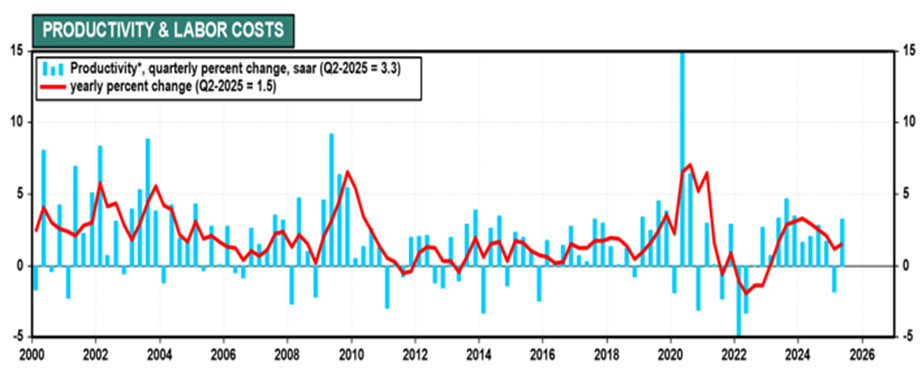
Why this matters for markets is the boost to earnings. When output per hour rises faster than pay, unit costs ease and margins widen. That gives companies room to absorb tariff-related input costs without passing everything through to price or slashing volumes. It also supports capex confidence because rising efficiency makes each incremental hire or server more productive. The result is healthier operating leverage even in a slower nominal environment.
There is a plausible engine behind the numbers. Adoption of AI and automation is spreading quickly and appears to be lifting productivity across coding, customer support and data-heavy tasks. That diffusion raises the average worker, and that is how economy-wide productivity accelerates. Put together, the earnings backdrop looks sturdier than the jobs headlines suggest. A cooling labour market with rising participation and steady wages, combined with improving productivity, is not a recession cocktail. It is the kind of foundation that can offset tariff friction, support real income, and extend the cycle. If the Fed cuts in September, it will be cushioning a slowing economy rather than rescuing a collapsing one.
UK politics, retail and markets
I typically prefer not to get involved in the drama of Westminster, but it becomes important for the markets when policy and data credibility are at odds. Keir Starmer’s government has attempted to reset with a reshuffle and a stronger stance on immigration. Although Labour appears dominant in Parliament, the political climate is less stable than it was a few months ago. Reform UK is polling at historically high levels and, in some recent surveys, is either tied with or even ahead of Labour, mainly by attracting disillusioned Conservatives. This situation adds another layer of uncertainty as investors prepare for the November Budget.
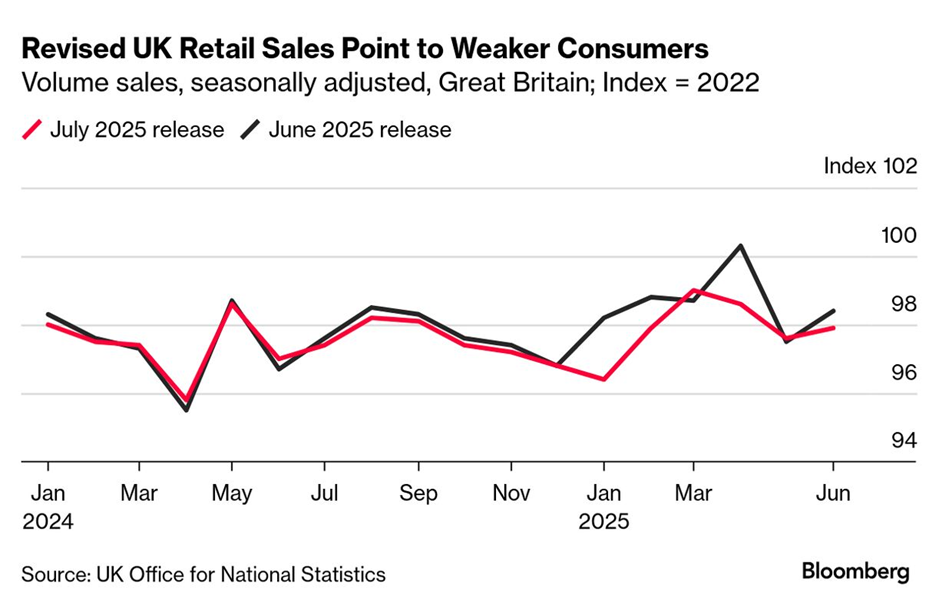
The week’s more practical development was retail. The Office for National Statistics admitted an error in its seasonal adjustment and revised the first half of 2025 retail-sales growth down to 1.1% from 1.7%. That trims roughly £2 billion from the earlier picture and reinforces the idea that households remain cautious. July itself still showed a monthly rise of 0.6% after a revised 0.3% in June, helped by better weather, new product launches and the women’s Euros, but the broader trend is softer than previously thought. The ONS apologised, explained the fix, and said the GDP impact is marginal, yet confidence in the data has clearly been dented.
For gilts, the backdrop remains delicate. Thirty-year yields are at their highest since the late 1990s. The Debt Management Office has already shortened the average maturity of issuance and reduced inflation-linked supply, recognising thinner demand from pension funds since the 2022 turmoil. Even so, the long end has stayed under pressure, not helped by the Bank of England selling down part of its portfolio. Governor Andrew Bailey has played down the move in ultra-long yields and indicated that the pace and mix of the Bank’s sales could be adjusted, which would help to steady things if followed through.
The outlook for equities is mixed rather than negative. The UK market remains relatively inexpensive by most measures, which keeps takeover interest alive and bolsters larger global earners, especially if the value of sterling stays low. However, domestic mid-cap companies require a more stable bond market and clearer pro-growth signals to unlock their potential value. The recent retail revisions support the argument for the Bank of England to remain cautious, even if it decides to cut interest rates again, as consumer momentum is not strong enough to drive the economy on its own. In this context, a calmer gilt market could serve as the simplest catalyst for improving the equity landscape.
Put together, the UK is caught between value and uncertainty. The political backdrop is noisier, the consumer is still careful, and the gilt curve is jumpy at the long end. If the Bank moderates its sales and the debt office continues to lean away from ultra-long issuance, yields should stabilise. Until then, it isn’t easy to see a decisive break higher in either gilts or UK-focused shares.
Europe
European data at the start of September presented a mixed but broadly stable picture. Headline inflation in the euro area edged up to an estimated 2.1% in August from 2.0% in July, which keeps the ECB cautious but not alarmed. Business surveys suggest activity remains modestly expansionary, with the composite PMI just above the 50 threshold. The message is one of subdued but continuing growth.
Equities reflected this mood, with the Stoxx 600 finishing the week little changed. Energy shares softened alongside oil prices, and banks lost some ground after the weaker US labour market data, but the overall picture was one of consolidation rather than stress.
Germany provided the main policy development. The government’s budget committee approved an investment-heavy plan for 2025, signalling a willingness to use fiscal support even as growth forecasts were revised down again in light of global trade frictions. The near-term impact on earnings is limited, but the longer-term message is that Germany is leaning into public investment to underpin demand.
For the ECB there is little urgency to change course. Inflation remains only slightly above target, and the Governing Council continues to reduce its balance sheet gradually. Markets will continue to adjust expectations around each release, but the default stance is patient rather than activist.
China
China’s latest data continued to show divergence between sectors. The official manufacturing PMI remained below 50 in August, pointing to ongoing contraction, while the services index rose to a fifteen-month high, suggesting parts of the domestic economy are still resilient. Trade momentum is weaker, with exports losing pace after an earlier improvement linked to tariff reprieves. Producer prices remain in deflation but are likely to be less negative in the months ahead, a small step towards stabilisation.
Credit figures remain a concern. The sharp fall in new bank lending in July underlined the caution among households and private firms. Broader measures of liquidity have improved compared with last year, yet the preference for saving over borrowing persists. The People’s Bank of China has so far opted for measured rather than large-scale easing, with the expectation of modest additional support later in the year if conditions soften again.
The property market continues to weigh on sentiment. Price declines have moderated, and several large cities have relaxed purchase restrictions, but confidence remains fragile and unsold inventory is still high. Policy support is increasingly focused on converting empty units into social housing rather than stimulating private demand, which suggests a gradual adjustment rather than a rapid recovery.

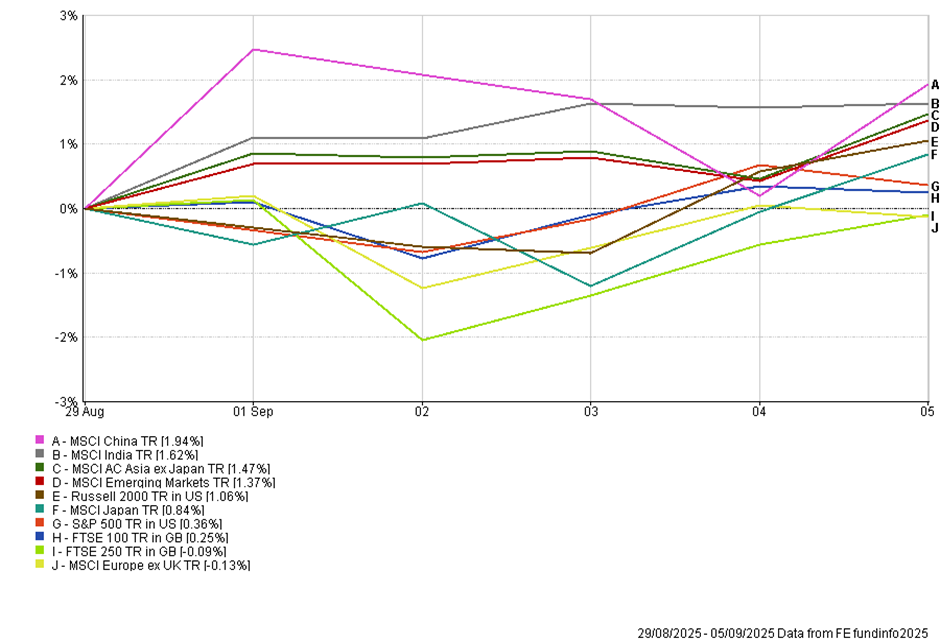
Chinese equities have performed strongly this year, contributing to the overall performance of emerging markets and keeping pace with their developed market counterparts. Interestingly, I noticed from the chart that in local currency terms, the US has now caught up with Europe! Valuations in China remain more reasonable compared to those in the US, and investments in AI and technology provide some support for earnings. However, the sustainability of these gains will depend on several factors: progress in credit growth, stabilisation in the property market, and fewer disruptions from trade disputes.
This Week…
The coming week keeps the spotlight firmly on the macro. In the US, all eyes turn to CPI and PPI updates for August. With the Fed now widely expected to cut in September, the inflation data will shape how many more moves follow before year’s end. Retail sales and industrial production will add colour on whether the consumer and manufacturing are holding up or slowing further.
In Europe, focus will be on the ECB meeting, where policy is set to remain unchanged, but the press conference could offer guidance on the pace of balance-sheet reduction. Updated inflation prints from Germany, France and Spain will provide an important cross-check on whether price pressures are easing. Labour market figures and a first read on August CPI will dominate the UK. Both will matter for the BoE’s September meeting, where the balance between weaker growth and sticky inflation remains finely poised. China releases its monthly activity data, including retail sales, industrial production and fixed-asset investment. These will be watched closely for signs that stimulus measures are starting to gain traction after a patchy summer.
On the micro side, earnings season is drawing to a close, but a few important names remain. In the US, results from Oracle and Adobe will provide an update on enterprise software demand and AI spending. European investors will focus on Inditex, a bellwether for global retail trends. In the UK, supermarket reports provide a fresh insight into household budgets and consumer caution.
In summary, it will be another busy week where inflation data and signals from central banks take centre stage. At the same time, company earnings will give a more detailed view of how resilient demand truly is.
This content is intended for financial professionals only. These are the author’s views at the time of writing and may be subject to change. This content is not intended to provide the basis for any investment advice or recommendation. Any forecasts, figures, opinions, tools, strategies, data, or investment techniques are included for information purposes only.
The information presented is considered to be accurate at the time of production and has been obtained from or based upon sources believed by the author to be reliable and accurate, but no warranty of accuracy is given and no liability in respect of any error or omission is accepted. Please visit our Regulatory Information and Terms of Use pages for more information.

 Production