

Space X rockets skyward as peace edges nearer in the Middle East
Author: Tom McGrath, CIO, 8AM Global Ltd
SpaceX IPO: The week ended with the largest IPO in history and a reminder that markets are still willing to fund extraordinary long-duration growth stories. SpaceX raised $75bn, priced at $135 per share and closed its first day up 19% at $160.95, leaving the company valued at around $2.2tn. It also made Elon Musk the world’s first trillionaire, which will inevitably become the headline, even if the more important market point is that demand from both institutions and retail investors was enormous.
Whether SpaceX proves to be a good investment from here is far less obvious. The company is loss-making, the valuation is heroic, and history is full of giant IPOs that looked wonderful on day one before struggling later. But in the near term, the listing tells us something useful about market psychology. Investors are still prepared to buy the future: reusable rockets, Starlink, defence, orbital infrastructure, AI, data networks and the wider Musk premium. At a time when investors are supposedly worried about inflation, rates and geopolitical risk, that level of demand is notable. It also improves the backdrop for other potential mega-cap AI-related listings, including Anthropic and OpenAI. However, it may also force investors to make room by trimming other crowded growth positions.
Again, the most important part of this story is the signal of positive interest and the support for the overarching market narrative and sentiment.
Middle East: Haven’t we been here before? Perhaps this time there is real progress towards an interim US-Iran agreement. Reports suggested that an interim deal could reopen the Strait of Hormuz, extend the ceasefire and create a framework for further negotiations over Iran’s nuclear programme. A senior US official put the chance of an agreement being signed soon at 80% to 85%, while Iranian officials also suggested that the Islamabad Memorandum of Understanding was closer than before.
Markets were right to welcome the news, but not to declare the risk over. We have been this close before (optically). The draft still needs approval from Iran’s Supreme Leader, there are conflicting descriptions from Washington and Tehran, and Israel is not directly part of the interim agreement. There are also important practical questions around what reopening Hormuz actually means. Before the conflict, roughly 140 ships passed through the Strait each day. Traffic has improved recently but remains well below normal levels, and there are concerns that mines may need to be cleared before shipping can properly recover.
The best framing is therefore not that peace has arrived, but that the ‘left-tail energy shock has been reduced. That was enough to help markets. Brent fell sharply from its April highs, European gas prices eased, and risk assets recovered into the end of the week. If the deal is signed and shipping normalises, the macro effect could be meaningful: lower oil prices, lower inflation pressure, some relief for consumers, and less pressure on central banks to tighten into a supply shock. If the deal disappoints, the market will quickly refocus on the same stagflation risks that dominated earlier in the conflict.
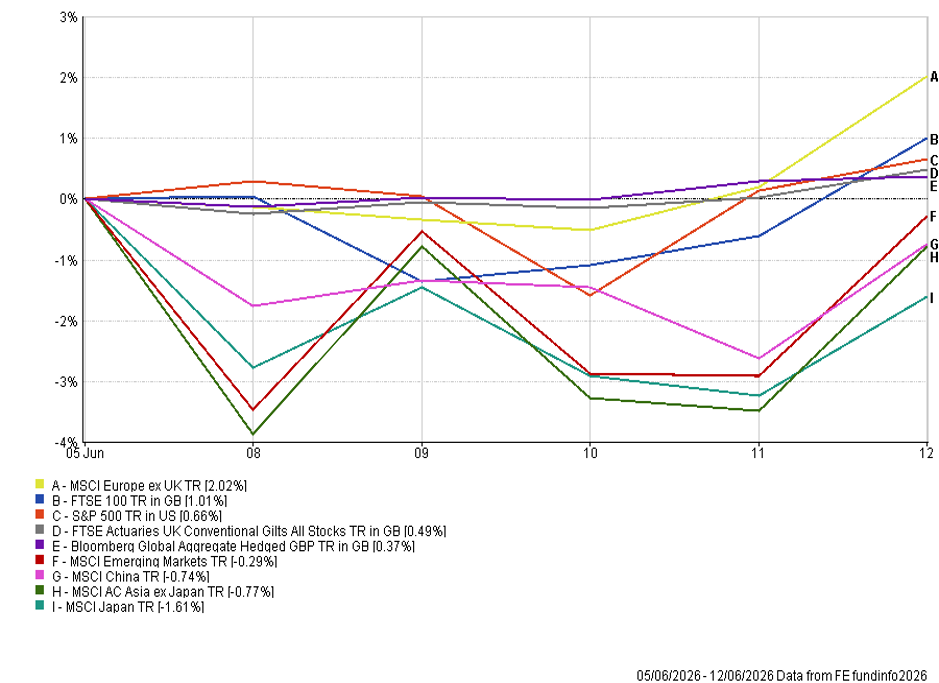
Weekly market performance reflected that mixture of relief and caution. MSCI Europe ex UK led the major markets, rising just over 2%, helped by lower energy prices and reduced stagflation fears. The FTSE 100 gained around 1%, while the S&P 500 rose around 0.6% after a late-week rebound. Gilts and global aggregate bonds also produced small positive returns. Emerging markets, China, Asia ex-Japan, and Japan lagged, indicating that this was not a simple, broad risk-on week. It was more of a relief rally in the assets most sensitive to energy prices and geopolitical stress.
US economic data: inflation is still the bigger story
Consumer sentiment improved in early June for the first time in four months, as lower gasoline prices provided households with some relief. The University of Michigan sentiment index rose to 48.9 from May’s record low of 44.8. One-year inflation expectations eased from 4.8% to 4.6%, while longer-term expectations fell back to 3.4%. That is welcome, but sentiment remains extremely weak by historical standards. Consumers are ‘slightly less gloomy’, rather than suddenly confident.
The bigger story was inflation. Headline CPI rose above 4% for the first time in three years, although the market reaction was relatively calm. Part of that is because the increase was heavily energy-related, and markets are now treating the Iran news flow as more important than backwards-looking inflation data. Core CPI rose but came in a little better than feared, and the numbers were not bad enough to put an immediate Fed rate hike on the table. A hold at next week’s meeting is still the overwhelmingly likely outcome.
However, the market may be taking the inflation data a little too calmly. Energy is the most obvious problem, but it is not the only one. Services inflation remains sticky, food inflation is still politically important, and broader measures of underlying price pressure have moved higher. The Fed’s preferred ‘supercore’ measure — services excluding housing — has strengthened, while sticky-price gauges are rising as well. That matters because it is becoming harder to blame the inflation problem purely on shelter or on a temporary oil spike. There were some more encouraging details. Tariff-related pressure in core goods appears to be fading as last year’s levies drop out of annual comparisons.
PPI reinforced that message. Producer prices showed that the energy shock is flowing through transportation, warehousing, goods prices and food costs. Small businesses appear particularly exposed. Input costs are rising, but not every company has the scale or pricing power to pass those costs on. Survey data suggest more firms have raised prices or plan to do so, while supply-chain disruption is weighing on confidence, hiring plans and capital expenditure. Larger companies are holding up better, helped by scale, access to capital and the ability to invest in AI. That creates a more divided economy: resilient large corporates, but increasing pressure on small businesses and lower-income consumers.
UK growth: first signs of the squeeze
The UK economy contracted by 0.1% in April, the first monthly fall in eight months. That followed a strong first quarter, when the UK had been one of the better-performing G7 economies, but the April data suggest that momentum is fading. Services fell 0.2%, more than offsetting gains in construction and manufacturing. Some of the services weakness was directly linked to the Middle East conflict, including the cancellation of sporting events in the region, while recruiters, retail and consumer-facing services were also weak.
The UK picture is therefore one of fragility rather than collapse. Higher fuel prices, rising utility bills, softer labour demand, weaker real pay growth and tighter financial conditions are beginning to bite. The data support Governor Andrew Bailey’s reluctance to rush into rate hikes in response to the energy shock. Inflation risk has risen, but demand is weakening. The Bank of England is likely to hold next week, while keeping the option of a later, limited hike open if inflation becomes more persistent.
ECB rate decision: one hike, then probably pause
The ECB raised rates by 25 bps, which seems understandable given the inflationary shock from energy and the need to protect credibility. Europe is the developed region most exposed to a prolonged Middle East energy shock, so the ECB could not simply ignore the risk that higher oil and gas prices feed into expectations, wages and second-round price effects.
The key point, however, is that this is unlikely to mark the start of an aggressive hiking cycle. The eurozone growth backdrop remains weak, manufacturing is vulnerable, and household confidence is sensitive to energy prices. If Hormuz reopens and energy prices continue to fall, the case for further tightening weakens quickly. The most likely path is therefore one insurance hike followed by a pause, with the ECB keeping a hawkish tone but waiting to see whether the energy shock persists or fades.
China AI rollout: a brighter part of the global picture
China provided one of the more constructive stories of the week. Exports rose more than 19% year-on-year in May, while imports jumped more than 27%. The driver was not a broad consumer revival, but the global AI infrastructure boom. Chips and computers accounted for roughly half the growth in both exports and imports. Semiconductor exports rose 111%, while computer and parts exports rose 66%.
This reinforces the view that China should not be seen only as a property-and-weak-consumer story. It is also deeply embedded in the physical layer of the AI buildout: servers, optical modules, data-centre components, power systems, batteries, cooling, networking and industrial supply chains. Beijing’s reported plan to spend around 2tn yuan over five years on a nationwide data-centre and computing network adds to that theme. China may not lead the US in frontier AI models. Still, it may become increasingly important in low-cost inference, industrial AI, domestic chip substitution and scaled deployment across manufacturing and public infrastructure.
This week…
…Comes down to three issues. First, does the US-Iran deal get signed, and does shipping through Hormuz actually begin to normalise? Energy remains the swing factor for inflation, consumers and central banks. If oil continues to fall, markets can look through the recent inflation spike. If the deal fails, stagflation risk comes straight back.
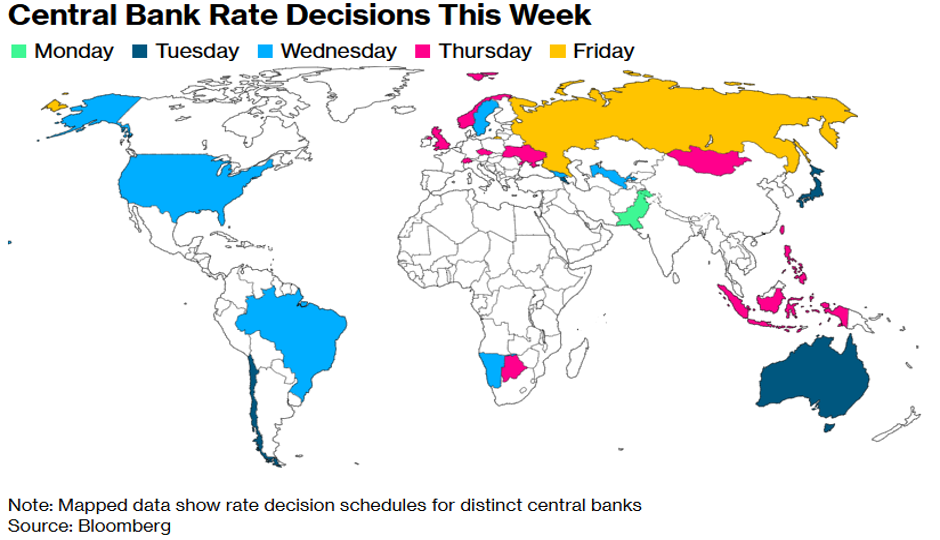
Second, it is a huge week for interest rates, with more than 20 central banks meeting. The Fed is expected to hold at its first meeting under Kevin Warsh’s chairmanship, but the tone will matter after firmer CPI and PPI data. The Bank of England is also likely to stay on hold, with weak UK growth arguing against a rushed hike even as inflationary pressures build. The ECB, having delivered what appears to be a necessary insurance hike, may now pause if energy prices ease. The Bank of Japan is the exception, with another rate rise expected as it continues to normalise policy.
Third, markets will watch whether the SpaceX IPO can hold its early gains, as that will influence appetite for the next wave of AI-related mega listings. Alongside that, China activity data will test whether the AI-led export boom is still strong enough to offset weak domestic demand.
So in a period of pivotal weeks for data… another pivotal week for data beckons!
This content is intended for financial professionals only. These are the author’s views at the time of writing and may be subject to change. This content is not intended to provide the basis for any investment advice or recommendation. Any forecasts, figures, opinions, tools, strategies, data, or investment techniques are included for information purposes only.
The information presented is considered to be accurate at the time of production and has been obtained from or based upon sources believed by the author to be reliable and accurate, but no warranty of accuracy is given and no liability in respect of any error or omission is accepted. Please visit our Regulatory Information and Terms of Use pages for more information.

 Production