

Is Goldilocks making a comeback?
Author: Tom McGrath, CIO, 8AM Global Limited
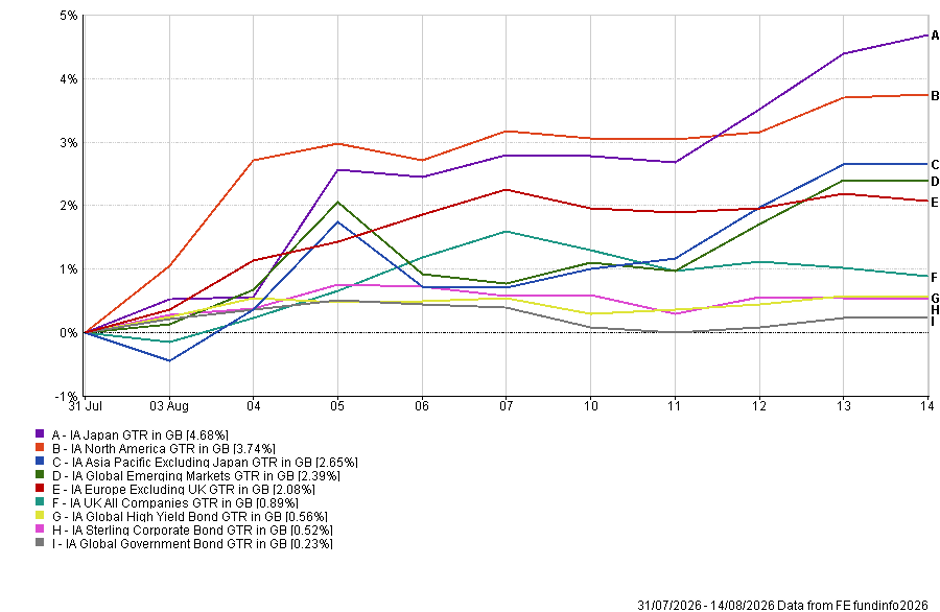
Markets have enjoyed a strong start to August. US equities reached fresh record highs during the week and, despite slipping back on Friday, the S&P 500 and Nasdaq completed a third consecutive weekly gain. More encouraging has been the breadth of the move. IA sectors since the end of July show Japan leading with a gain of nearly 5%, followed by North America at 3.7%, Asia Pacific ex-Japan at 2.7%, Emerging Markets at 2.4% and Europe ex-UK at just over 2%. The UK has lagged, although it remains positive, while corporate and government bonds have also made modest gains. Meanwhile, the VIX volatility index has fallen to its lowest level of the year. The advance is no longer confined to a narrow group of US technology companies; participation across regions, sectors and asset classes has become considerably broader.
The improvement in breadth is welcome, although it is not yet uniform. Aggregate US earnings growth remains heavily influenced by the leading AI companies, while global equity funds attracted strong inflows but technology funds experienced net selling. This suggests broader risk appetite, but also more discriminating capital allocation.
There may be a more fundamental reason for this improved tone. For much of the year, investors have faced an uncomfortable trade-off. Stronger growth risked keeping inflation high and forcing the Federal Reserve to tighten policy further, while weaker growth might solve the inflation problem only by undermining earnings and raising the risk of recession. Over the past couple of weeks a more attractive third possibility has begun to emerge. Inflation has moderated, expectations for further Fed tightening have fallen sharply and yet corporate earnings remain robust. It is too early to conclude that Goldilocks has returned, but the balance between growth, inflation and interest rates is beginning to look considerably less hostile.
US macro – threading the needle
Inflation provided the principal reassurance this week. US consumer prices rose by just 0.1% in July, taking the annual rate down to 3.4%, while core inflation eased to 2.5%. Producer prices were flat overall as lower goods and energy prices offset firmer services. There are still areas of pressure beneath the headline figures, particularly in services, and inflation remains above the Federal Reserve’s target. Nevertheless, the direction has improved and, importantly, some of the inflationary forces that concerned markets earlier in the year have not yet fed through as aggressively as feared. However, the detail was less uniformly benign: final-demand services rose 0.2%, while the measure excluding food, energy and trade services increased 0.4% month on month and 4.7% year on year.
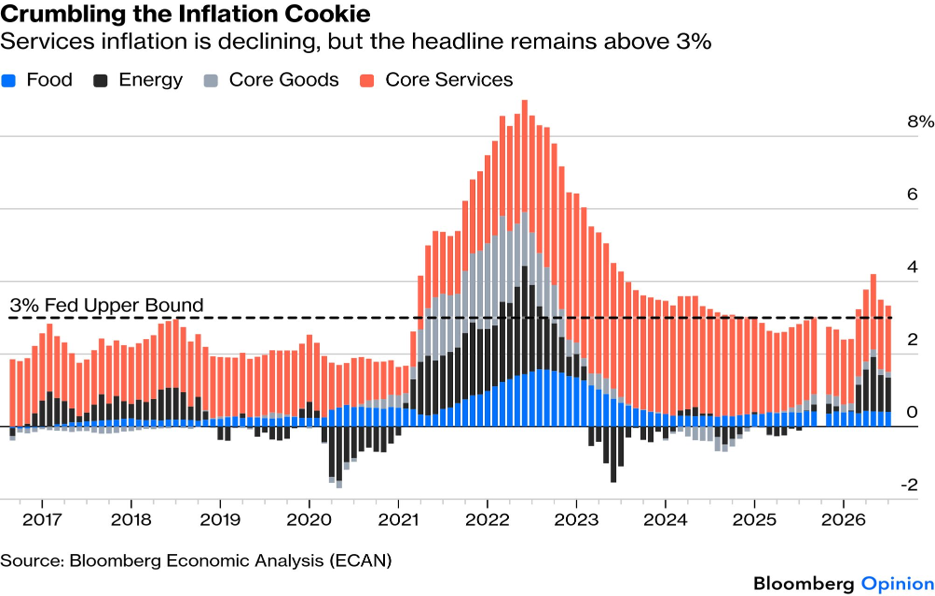
Markets responded quickly. The implied probability of a September Fed rate increase fell from roughly even odds before the inflation releases to about one-third by Friday. Recent moderation in wage growth, improving productivity and tentative signs of softer shelter inflation all strengthen the argument that the Fed can afford to remain patient rather than react to every temporary movement in energy or tariff-affected goods prices. Chicago Fed President Austan Goolsbee said on Thursday that the figures were encouraging, while stressing that the improvement needed to continue.
Long-term bond markets remain less convinced. Government bonds have made only modest progress during August despite the improvement in inflation and the reduction in expected Fed tightening. That appears to reflect a broader set of concerns around US fiscal borrowing, heavy global capital requirements and a higher term premium. Government deficits are competing for capital at the same time as unprecedented sums are being required for AI infrastructure, power generation, defence and the reshaping of global supply chains. A more benign Fed outlook may therefore pull shorter-term yields lower without necessarily restoring the very low long-bond yields of the previous decade. That tension is visible in the US 30-year real yield, which is close to 3% and around an 18-year high, while Alphabet, Amazon and Meta have issued nearly $220 billion of debt during 2026. The long end is therefore pricing both fiscal supply and an increasingly capital-intensive AI cycle.
There was also an important counterpoint to the benign inflation story. US retail sales fell 0.6% in July, the largest monthly decline for more than a year, while the measure of spending that feeds more directly into GDP also weakened. Consumer sentiment fell sharply, with higher petrol prices increasingly weighing on household purchasing power. Coming after July’s disappointing payroll report, these figures deserve more attention than they might have received in isolation.
There are, however, reasons not to overstate the weakness. The movement of Prime Day into June and the fading of earlier tax-refund support affected the comparison; lower July fuel prices reduced nominal petrol-station receipts even though elevated household fuel costs continued to weigh on sentiment. More importantly, corporate results continue to portray a consumer who is becoming more selective rather than withdrawing altogether. Some slowing in employment, wages and spending is exactly what the Fed requires if inflation is to return sustainably towards target. The risk is that this benign cooling gathers momentum. Earlier in the year the dominant concern was that stronger growth, tariffs and higher energy prices would force the Fed to tighten again. That risk has diminished somewhat; the emerging question is whether growth can now slow sufficiently to ease inflation without pushing unemployment materially higher. For the time being, the evidence remains consistent with a soft landing, but the margin for error has narrowed.
AI – follow the money
One reason markets remain comfortable with that macro slowdown is that there is still little sign of a comparable deterioration in corporate earnings. This week’s results provided further evidence that the extraordinary AI investment cycle remains intact and, increasingly, that the capital being spent by hyperscalers is flowing rapidly into revenues across the wider economy.
CoreWeave more than doubled quarterly revenues and reported an order backlog of more than $100 billion, while again highlighting the scale of the investment required to meet demand. Super Micro Computer continued to point to strong demand for AI servers. Cisco provided perhaps the more interesting read-through, reporting $9.3 billion of AI infrastructure orders from hyperscale customers during its latest financial year, with around $4 billion already converted into revenue. The importance of these numbers is not simply their scale, but what they tell us about the widening economic footprint of AI investment.
Demand visibility remains strong, but funding quality is becoming equally important. Reported Nvidia-backed infrastructure plans aim to mobilise more than $500 billion of third-party capital, potentially including backstops of up to $125 billion. CoreWeave, meanwhile, is guiding to $35–39 billion of capital expenditure against a backlog of approximately $104 billion. Cash conversion, utilisation and financing terms are therefore becoming as important as order growth.
The debate over whether Microsoft, Alphabet, Meta and the other hyperscalers will ultimately earn adequate returns on the extraordinary amounts they are investing remains entirely legitimate. That question will become increasingly important as the installed asset base grows and depreciation charges rise. What is much clearer today, however, is that the investment itself is creating substantial revenue elsewhere. Data centres require servers, memory, networking, cooling systems, power generation, electrical equipment and cabling. The first phase of the AI trade was largely about semiconductors and hyperscalers; the current phase is increasingly about the physical infrastructure required to support them.
The same dynamic is evident in Asia. Tencent delivered solid revenue growth while continuing to increase investment in computing capacity, and AI is already improving monetisation within its advertising business. The quarter was not unambiguously strong, however. Revenue rose 11%, but IFRS attributable profit was broadly flat and below expectations, while capital expenditure increased 176% year on year to RMB52.8 billion. The positive is improving AI monetisation; the trade-off is a considerably heavier investment burden. Chinese semiconductor manufacturer SMIC also reported strong revenues amid constrained capacity. South Korea, meanwhile, has recovered some stability after the sharp volatility of July, with investors returning to semiconductor and memory companies as the underlying demand for high-bandwidth memory remains strong.
Europe – picks and shovels
Europe’s reporting season has been stronger than expected. STOXX 600 second-quarter earnings growth is estimated at 23.4% year on year, or 12.3% excluding energy, with 58.6% of companies beating estimates compared with a long-run average of 54%. The significance is not simply that European earnings have surprised positively, but that the region has useful exposure to some of the same structural investment themes supporting US growth.
Europe does not possess many direct equivalents of the large US technology platforms, but it has a formidable group of companies supplying the physical infrastructure required to build the digital economy. Siemens, Schneider Electric, ABB, Legrand and Prysmian provide power management, industrial automation, electrical equipment and cabling, while ASML remains critical to advanced semiconductor manufacturing. Recent results have again highlighted very strong demand from data-centre customers. This is increasingly Europe’s contribution to the AI cycle: less about platforms and software, and more about supplying the picks and shovels required to build the infrastructure underneath them.
That also helps explain why the global equity rally has broadened. There is an important difference between a market being driven purely by expectations of ever-higher valuations for a small number of US technology companies and one in which the associated investment cycle is beginning to generate earnings across industrials, electrical equipment, semiconductors, memory and infrastructure companies around the world. The latter is a considerably healthier foundation.
UK – growth resilience raises the rate hurdle
UK GDP rose 0.4% in the second quarter and 0.3% in June. Services drove the monthly gain, while production and construction softened, and the Bank of England’s Huw Pill argued that the data supported the case for higher rates. Company news was more encouraging: Balfour Beatty upgraded its outlook and Aviva reported a 24% increase in operating profit. For UK investors, firmer activity may support earnings, but could also keep gilt yields and policy expectations elevated.
Iran – pressure without escalation?
The principal external threat to this more benign macro picture remains Iran and the oil price. Brent settled at $88.52, up 6% over the week, after two further vessel attacks and sharply reduced traffic through the Strait of Hormuz. This is a more material transmission channel than equity markets alone suggest: sustained disruption would feed into petrol prices, inflation expectations and the Fed’s room for manoeuvre. The emphasis from the US appears, at least for now, to be shifting towards sanctions, economic isolation and maintaining pressure through the naval blockade rather than immediately embarking on another major escalation.
There are sound reasons for such an approach. Higher gasoline prices are already eroding US consumer purchasing power and confidence, and another substantial rise in crude would complicate the inflation picture just as the Fed appears to be gaining some room for manoeuvre. There are military considerations as well. The conflict has drawn heavily on US stocks of some precision weapons. Reports indicated that USS George Washington was being sent to relieve USS Abraham Lincoln after a deployment of more than 260 days, highlighting the strain on US naval capacity. None of this precludes further military action, but it does give Washington an incentive to intensify economic pressure while avoiding a further oil-price shock if possible.
For markets, oil remains the principal channel through which Iran could upset the current equilibrium. A sustained move materially above present levels would simultaneously squeeze household incomes, raise headline inflation and make the Fed’s task more difficult. Conversely, a period of relative stability around current prices would allow the underlying disinflationary forces in the US economy to become more visible.
Asia/Japan – the recovery broadens
July producer prices rose 7.2% year on year and yen-based import prices increased 29.1%, strengthening the case for a possible September Bank of Japan rate increase. That backdrop is supportive for banks, but raises duration risk for Japanese government bonds and currency sensitivity for exporters.
Asia has been one of the strongest areas of the market so far this month. Korea seems to have recovered from July’s disorderly sell-off, when leveraged positions and forced selling amplified concerns around technology valuations. The underlying semiconductor story, particularly around memory and AI infrastructure, remains considerably stronger than the price action briefly suggested.
China is more complicated. July’s credit data reinforced the divergence: new yuan loans contracted by a record RMB340 billion, household borrowing fell RMB460.3 billion and annual loan growth slowed to a record-low 5.1%. The weakness remains concentrated in household and property demand rather than the strategic technology complex. Domestic credit demand remains weak and household borrowing is subdued, continuing to reflect the difficulties in property and consumer confidence. Yet parts of the technology economy are operating to a very different rhythm, with continued investment in AI and semiconductor capacity. This divergence between a relatively weak domestic macro backdrop and strong strategic technology investment remains one of the defining features of China today.
Taken together, these developments leave markets in an unusually balanced position. Growth is slowing but has not collapsed, inflation is moderating, the Fed has more room to wait and corporate earnings continue to expand. AI investment remains an important prop to global activity, but the benefits are now spreading far beyond the original handful of US winners. The main question is whether the current moderation in US demand remains controlled. If it does, the ingredients for a more durable Goldilocks environment are becoming increasingly visible.
Looking ahead…
It is clearly too early to declare that Goldilocks has returned. There are still plenty of ways in which the current balance could be disturbed, not least another escalation in the Middle East and a renewed rise in oil prices, while the recent softening in the US labour market and consumer data needs watching carefully. Nevertheless, as we approach the traditionally more difficult months of September and October, the underlying backdrop remains reasonably constructive.
The corporate reporting season has been exceptionally strong, with the great majority of US companies beating earnings expectations, while results from the technology and infrastructure complex have provided little evidence that the extraordinary AI investment cycle is losing momentum. Indeed, one of the more reassuring developments has been the widening of that investment boom into semiconductors, networking, power, cooling and industrial equipment, helping earnings growth to broaden beyond the original handful of technology leaders.
This week…
This week should provide some useful tests. Japanese GDP and Chinese activity and property data arrive on Monday, followed by UK labour data and BHP on Tuesday. UK inflation and the Fed’s July minutes will shape rate expectations. After Friday’s weaker retail-sales figures, results from Home Depot, Target, Lowe’s and Walmart should clarify how higher fuel costs and softer wage growth are affecting the US consumer. Alibaba reports on Thursday, with flash business surveys later in the week.
Together, these releases will test whether stronger markets reflect broader growth rather than solely easier Fed expectations. For now, earnings remain strong, AI investment continues at pace and inflation is moving in the right direction. That is not quite Goldilocks, but it is a considerably more comfortable position from which to approach the autumn than seemed likely only a few weeks ago.
This content is intended for financial professionals only. These are the author’s views at the time of writing and may be subject to change. This content is not intended to provide the basis for any investment advice or recommendation. Any forecasts, figures, opinions, tools, strategies, data, or investment techniques are included for information purposes only.
The information presented is considered to be accurate at the time of production and has been obtained from or based upon sources believed by the author to be reliable and accurate, but no warranty of accuracy is given and no liability in respect of any error or omission is accepted. Please visit our Regulatory Information and Terms of Use pages for more information.

 Production