

A better economy, but a harder bond market
Author: Tom McGrath, CIO, 8AM Global Limited
The week delivered a curious combination: better economic news, a resilient equity market and yet another warning from global bonds. August US payrolls rebounded, business surveys remained comfortably expansionary and productivity continued to improve. Ordinarily, that would be an uncomplicated positive. But with Brent crude close to $100 a barrel, diesel prices at record levels and governments asking investors to absorb ever more debt, stronger growth also gives central banks less reason to relieve the pressure. The economy looks healthier than the mood in bond markets, but the price of capital is rising.
A tension is building. The constructive interpretation is that AI investment, capital spending and productivity are allowing output and profits to grow without an equivalent acceleration in wages. The less comfortable interpretation is that firm demand, constrained energy supply and heavy borrowing will keep inflation sticky and real yields elevated. Both can remain true for a while: a reasonable environment for earnings, but a much less forgiving one for expensive or heavily financed assets.
Jobs stabilise rather than reaccelerate
The August employment report was the week’s main economic event. The US added 162,000 jobs, comfortably ahead of expectations, while unemployment held at 4.1% even as more people entered the labour force. June and July were also revised up by a combined 55,000 jobs. Food services and local government education supplied 101,000 of August’s gain, while manufacturing added 16,000. Construction rose by 22,000, although the BLS described employment as little changed.
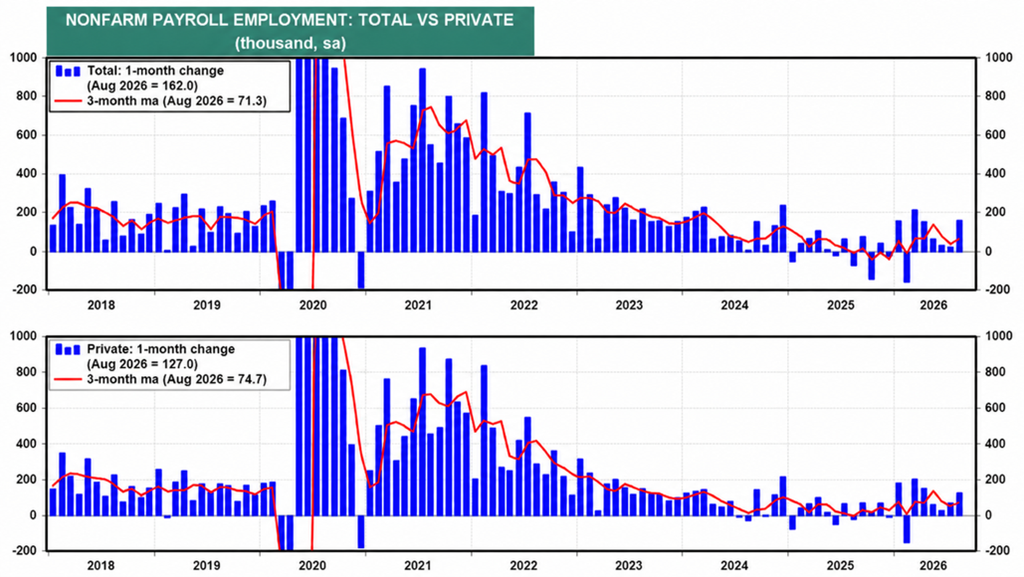
August was a clear improvement, particularly in private employment, but it did not restore the hiring rates of 2021-23. Job openings, hiring and quits still described a low-hire, low-fire labour market. This is stabilisation rather than a renewed boom: the risk of a labour-market break has receded without creating an obvious wage spiral.
Average hourly earnings rose 0.3% on the month and 3.1% over the year, while the average working week edged up to 34.4 hours. This supported nominal household income without an obvious acceleration in wage pressure. Following last week’s hawkish message from Jackson Hole, the report keeps a September rate increase in play; the inflation releases remain crucial.
Productivity – and an unlikely optimist
The revised second-quarter figures showed non-farm business productivity rising 2.2% from a year earlier, with unit labour costs up just 1.4%. Productivity growth over the current business cycle has averaged 2.1%, ahead of the previous cycle’s 1.5%. That is encouraging for margins and inflation, although real hourly compensation was still 0.1% lower than a year earlier.
Quarterly data points are volatile and it is too early to credit AI for every improvement. Even so, the direction is consistent with the benign technology thesis: stronger productivity would allow real income gains while protecting margins and containing unit-cost inflation. The harder test is whether the huge investment in digital infrastructure lifts output throughout the wider economy.
There is a telling anecdote here. Nouriel Roubini earned the nickname ‘Dr Doom’ after warning about the vulnerabilities that culminated in the global financial crisis. Yet he has become one of the more striking advocates of a technology-led boom, arguing that AI, robotics, biotechnology, advanced materials, energy innovation and other technologies could lift US potential growth materially by the end of the decade. Roubini has not stopped seeing debt, geopolitical or market risks, but his optimism about productivity is notable precisely because it comes from someone professionally associated with worst-case outcomes. This week’s figures do not prove his thesis, but they move modestly in its direction.
Broadcom supplied a tangible example, reporting quarterly revenue of $29.6 billion, up 86%, and free cash flow of $13.7 billion. Yet its shares fell 2.7% on 3 September following the results. Strong demand is generating cash, but demanding expectations leave little room for disappointment.
PMIs point to broader, uneven growth
The business surveys reinforced the message that global growth is broadening rather than breaking. The ISM manufacturing PMI eased from 55.6 to 54.6, still comfortably expansionary, while services strengthened from 54.1 to 55.4. Services employment remained below the expansion threshold at 47.8, despite a modest improvement, while prices paid rose to 72.6. Demand is firm, but hiring remains cautious and cost pressures uncomfortable.
The improvement was not confined to America. Eurozone manufacturing recorded its strongest reading in more than four years, with Germany showing welcome momentum. China’s private manufacturing and services PMIs improved to 51.5 and 51.4 respectively, qualifying last week’s weaker official-survey picture. Different survey samples help explain the divergence: the official manufacturing PMI remained below 50 at 49.8. The evidence points to an uneven improvement, rather than a broad recovery. The UK remained in modest expansion, although construction PMI fell to 44.3. The Bank of England’s business survey offered a useful counterpoint: inflation expectations eased, but 61% of firms expected the energy shock to reduce margins. The survey preceded the latest escalation in oil prices. This is not a synchronised boom, but neither does it support an imminent global recession.
Oil’s inflation threat is moving beyond crude
Brent approached $100 during the week before finishing Friday around $96. US retail diesel reached a nominal national-average record of $5.85 a gallon, as disruption to Middle Eastern supply and Russian refining intensified pressure on refined fuels. In a further development after Friday’s close, US forces struck Iranian crude carriers on Saturday, adding another risk to physical supply.
Diesel matters more to the inflation outlook than its profile in financial markets suggests. It powers freight, farming, construction and delivery networks, so the shock passes into the cost of a wide range of goods. The widening gap between crude and diesel prices shows that this is not simply an oil-price story; it is also a refining and distribution squeeze. Central banks can look through a brief energy move, but a six-month disruption affecting transport, food and inflation expectations is harder to dismiss as temporary.
Bond markets aren’t only worried about inflation
Government borrowing costs rose sharply, with long-dated gilts reaching yields last seen in 1998 and German benchmark yields touching 15-year highs. Some pressure eased later in the week, including a sharp gilt rally on Thursday, although financing conditions remained demanding. The drivers differed across markets. Higher real yields were an important part of the US story, while inflation expectations also weighed on UK and European bonds. Heavy issuance and fiscal concerns may be adding to the pressure, but the relative contribution of each cannot be read directly from nominal yields.
The AI investment boom may itself be competing with governments for finance. Highly rated technology companies are issuing debt for data centres just as sovereign borrowing remains enormous. Meanwhile, memories of recent losses make investors reluctant to move from cash and short maturities into the long end. Bonds may look cheap, but buyers can reasonably believe they will be cheaper tomorrow.
The same investment cycle extends into property. Equinix and its partners completed the $4 billion acquisition of Nordic data-centre operator atNorth, with Equinix committing $895 million for approximately 34%. The opportunity is substantial, but the eventual return still depends on development, power availability and financing costs.
The UK demonstrates how this becomes a fiscal problem. Chancellor John Healey has warned that the Middle East conflict is simultaneously lifting inflation, weakening growth and raising borrowing costs. Pantheon Macroeconomics estimated that higher debt-servicing costs could reduce fiscal headroom from £23.6 billion to around £13 billion if elevated yields persist. Ahead of the 28 October Budget, that would further constrain Chancellor John Healey’s room to reconcile spending ambitions with fiscal discipline. This raises the risk of the feared loop in which higher yields worsen the fiscal position and create still more borrowing, although it is a risk rather than an inevitability.
Japan Leads a Resilient Week
The returns chart shows that this was not a conventional risk-off week. In sterling total-return terms, MSCI Japan led with 1.92%, followed by emerging markets at 0.71% and the S&P 500 at 0.57%. MSCI Europe ex-UK and China fell 0.57% and 0.37%, while the FTSE 100 and UK gilts were broadly flat.
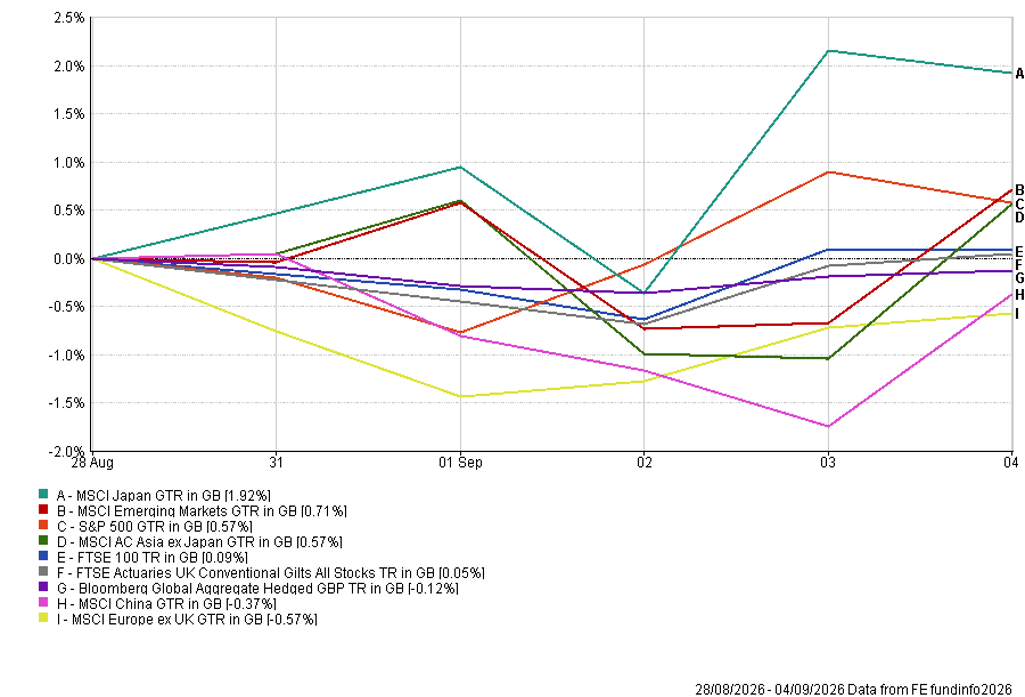
Japan’s sterling return benefited from yen strength. Expectations of further Bank of Japan tightening, the unwinding of yen shorts and reported Japanese sales of foreign bonds offered plausible explanations. Higher domestic yields may encourage further repatriation, but one week does not establish a lasting reversal of overseas investment. If decades of Japanese savings flowing into Treasuries and other government markets begin to reverse, the global supply of cheap capital becomes less dependable. Equities have so far absorbed that prospect because earnings remain strong, but a further rise in real yields would increasingly test valuations.
Fund flows showed caution beneath the calm surface. Global money-market funds attracted $46 billion in the week to Wednesday, their strongest inflow for nearly a month, while US equity funds suffered outflows even as European, Asian and emerging-market funds continued to attract money. Short-dated bonds were also preferred to government and corporate duration. Investors are not abandoning risk, but they are demanding liquidity, diversifying geographically and remaining reluctant to make a large duration call. That is consistent with the chart: risk appetite survives, but it is becoming more selective.
This week…
US August PPI on Thursday 10 September and CPI on Friday 11 September will be important inputs ahead of the 15–16 September FOMC meeting. They will offer an initial test of underlying price pressure, but cannot capture the full impact of the latest energy disruption. Thursday’s ECB decision and Friday’s UK July GDP release will provide further tests of the balance between activity, inflation and financing costs.
The central question is now clearer. Can productivity absorb stronger wages and higher energy costs quickly enough to sustain growth without reigniting inflation, or will resilient demand and scarce capital keep real yields moving higher? For now, jobs have stabilised, corporate activity is expanding and the productivity evidence is encouraging. That supports remaining constructive, provided earnings delivery continues. As we have discussed in recent weeks, financing conditions are becoming less forgiving. A soft landing remains plausible, but sustained energy pressure and higher real yields would narrow the range of valuations that earnings can support.
This content is intended for financial professionals only. These are the author’s views at the time of writing and may be subject to change. This content is not intended to provide the basis for any investment advice or recommendation. Any forecasts, figures, opinions, tools, strategies, data, or investment techniques are included for information purposes only.
The information presented is considered to be accurate at the time of production and has been obtained from or based upon sources believed by the author to be reliable and accurate, but no warranty of accuracy is given and no liability in respect of any error or omission is accepted. Please visit our Regulatory Information and Terms of Use pages for more information.

 Production