

Warsh puts rate hikes back in play; Nvidia delivers
Author: Tom McGrath, CIO, 8AM Global Limited
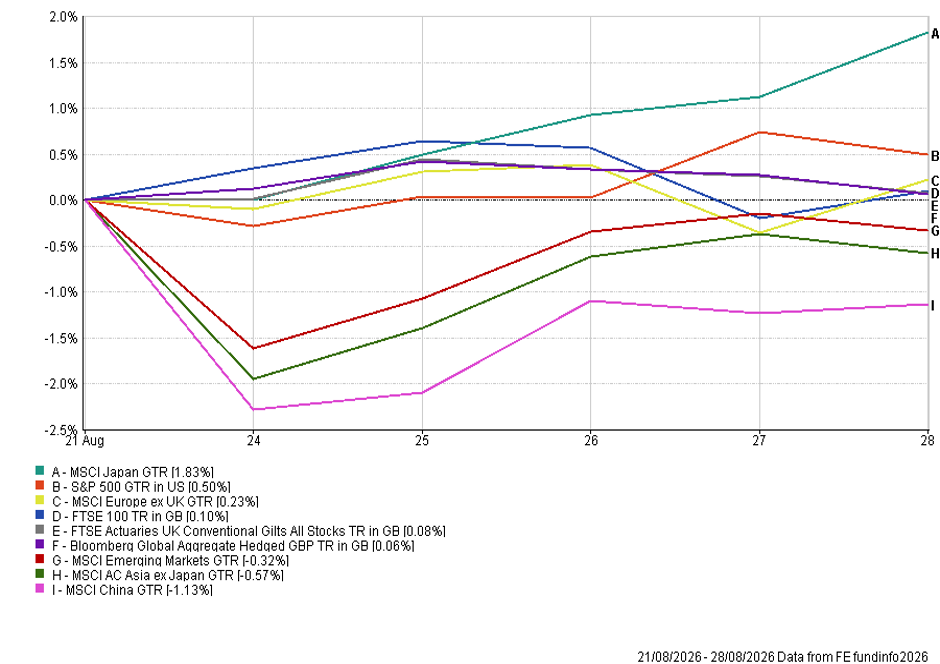
Global markets were relatively calm on the surface last week, but beneath that there was a noticeable shift in the macro backdrop. The strongest message came from the US, where economic activity continued to hold up, inflation remained uncomfortable and the Federal Reserve used Jackson Hole to remind investors that further tightening remains possible if underlying inflation does not move convincingly back towards 2%. At the same time, Nvidia’s results provided another powerful confirmation that the AI investment cycle remains intact, helping to offset some of the pressure from higher yields. Europe and the UK continued to show modest signs of resilience, while Japan remained one of the stronger equity markets and China continued to struggle with the familiar divide between a reasonably healthy export and technology sector and weak domestic demand.
Overall, it was a week that reinforced two themes we have discussed for some time: the global economy is holding up better than expected, but that durability is making the inflation and interest-rate backdrop less comfortable.
Jackson Hole changes the interest-rate debate
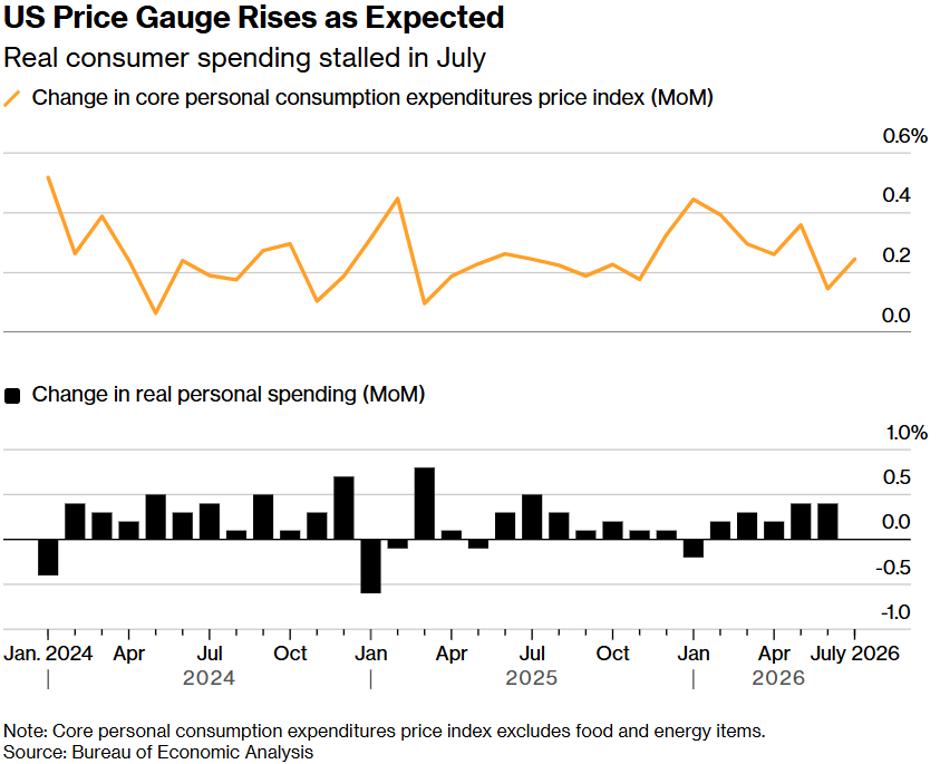
The US economy continues to prove resilient, but not uniformly so. Second-quarter GDP grew by only 1.5% annualised, but that understated private-sector momentum: real final sales to private domestic purchasers rose 4.2%, supported by 3.4% growth in consumer spending and 8.5% growth in non-residential fixed investment. July was less uniformly strong. Headline and core PCE inflation each rose 0.2% on the month, leaving the annual rates at 3.7% and 3.3% respectively, while real consumer spending was essentially flat. Housing remains rate-constrained and confidence weak. The labour market is better described as low-hiring and low-firing: layoffs remain subdued, but hiring has stalled and participation has fallen. The US therefore still has reasonable growth and an inflation problem, but less labour-market momentum than the unemployment rate alone suggests.
That was the backdrop to Kevin Warsh’s closely watched Jackson Hole speech. Warsh made no commitment on September, but set out a distinctly hawkish reaction function: inflation remains too high, labour is consistent with full employment and financial conditions are providing little visible restraint. Expectations of a September increase rose from roughly 35% before the speech to about 58% by Friday’s close. The reaction was concentrated at the front end: the two-year Treasury yield rose 14 basis points against six for the ten-year, bear-flattening the curve. Unlike July’s long-end-led move, that pattern was consistent with a repricing of near-term Fed policy rather than a fresh fiscal-risk sell-off. The dollar strengthened and equities gave back some ground on Friday without erasing their weekly gains.
Nvidia reminds us that the AI cycle remains very much alive
Nvidia provided the other major event of the week and once again the numbers were extraordinary. Revenue reached $96.2 billion, 106% above the level a year earlier, while Data Centre revenue rose to $89 billion. The third-quarter revenue guide of approximately $108 billion confirmed that demand remains exceptionally strong. The shares rose 8.7% after the results but surrendered part of that gain on Friday, finishing the five-session period 1.3% higher. Gross-margin guidance of around 74%, against 75% in the second quarter, also supports the distinction between strong demand and rising delivery costs. Whatever concerns investors may have about valuations or the amount being spent on AI infrastructure, there is still little evidence that demand for compute itself is weakening.
There are undoubtedly risks building around the edges of the AI investment boom. Memory and other component costs are rising, gross margins are likely to moderate and enormous amounts of capital are increasingly required to finance the next stage of infrastructure expansion. Larger commitments through debt, private capital, long-term customer contracts and more complicated structures are being used to fund the compute and power capacity required. Those issues matter and we continue to watch them closely. However, financing risk and demand risk are not the same thing. The financing side of the cycle is becoming more stretched, but Nvidia’s results strengthened rather than weakened the conclusion that underlying demand remains robust.
As we noted earlier in August, the market is moving from AI promises to evidence. Nvidia has answered the immediate demand question; it has not settled who ultimately converts that demand into durable cash flow after the capital bill. Nvidia’s new $3.5 billion investment in MediaTek convertible bonds and SK hynix’s more than $4 billion Indiana HBM facility illustrate both the depth of the ecosystem and its rising capital intensity. The MediaTek announcement came on Monday and therefore sits outside the five-session market window.
It is also worth remembering that Nvidia increasingly sits at the centre of a much broader industrial cycle. Strong demand is feeding through into memory, networking, power equipment, cooling, data-centre construction and custom silicon. That does not mean every AI-related company will be a winner, nor does it mean valuations can be ignored, but the investment cycle remains powerful.
The week also rewarded stock-specific delivery rather than a single macro factor. CrowdStrike rose 13.8% after strong net-new annual recurring revenue, while Eli Lilly fell 6.4% over the same period despite a positive Mounjaro cardiovascular label update. Nvidia’s own results-day surge and subsequent retracement reinforced the same point: positioning and the discount rate mattered alongside company news.
[Monday Flash] Hormuz returns as the key geopolitical risk
In a Monday-morning development after our normal review period, US forces struck two launchers on Larak Island that they said were being prepared to fire rockets carrying sea mines into the Strait of Hormuz. Iranian authorities subsequently said missiles had targeted two facilities hosting US forces in Jordan; separately, the UAE reported intercepting an Iranian drone. Reported immediate damage was limited, but the more important issue for markets is the renewed threat to shipping. Before this year’s disruption, Hormuz carried roughly one-fifth of global petroleum-liquids consumption and around one-fifth of global LNG trade—figures that describe pre-war flows rather than current throughput. US officials said key transit lanes had been cleared, although the status of any residual mines and the wider approaches remained uncertain.
Brent ended Friday at $89.31 a barrel, down 5.4% over the five sessions, before rising back above $90 on Monday. The lasting inflationary significance will depend less on the initial price gap than on whether hostilities or physical shipping disruption persist. A sustained return to conflict would feed directly into the inflation and interest-rate debate at a time when central banks are already struggling with persistent price pressures. Diplomatic channels remain open, but there has been no confirmed return to formal negotiations, while Washington continues to tighten sanctions on Iran’s oil-export network. Hormuz therefore remains one of the clearest potential transmission mechanisms from the conflict into global growth, inflation and monetary policy.
Europe and the UK – resilience is complicating the rate outlook
The European news was a little better last week, particularly in Germany, where second-quarter GDP was revised to 0.3% quarter on quarter. The Ifo business-climate index rose from 86.7 to 88.8, its highest reading since August 2025. The recovery is still modest and France remains softer, but the broader picture is one of an economy proving more resilient than feared. That matters for the ECB because inflation is also proving sticky: France’s preliminary harmonised inflation rate accelerated to 2.7%, although national CPI was 2.4%. The ECB’s July account indicated that another increase would probably be required unless the inflation outlook improved significantly. Reports point towards a September move, but the Governing Council has not pre-committed.
The UK picture is similar on growth but somewhat different on policy. The Lloyds Business Barometer rose four points to 53%, its highest since March, while activity remains modestly positive. Softer labour-market conditions are helping to contain second-round inflation pressures, which Andrew Bailey continued to describe as subdued, although he retained the Bank’s data-dependent stance. As of Thursday, markets did not fully price a 25-basis-point increase until February 2027. Overall, both economies are holding up better than expected, but the ECB looks closer to another increase while the Bank of England has more room to wait.
Japan leads Asia while China’s recovery remains uneven
The MSCI Japan gross-total-return series gained 1.8% over the five sessions, comfortably ahead of the other major equity markets shown in the chart. Semiconductor shares benefited from Nvidia’s results, while a still-weak yen supported translated exporter earnings. The same currency backdrop, however, raises imported energy costs and complicates the Bank of Japan’s task. Expectations of further monetary tightening continue to build, leaving the BOJ to normalise policy without creating an excessive rise in bond yields or an abrupt reversal in Japanese risk assets.
China remains much less convincing. August’s official manufacturing PMI improved from 49.2 to 49.8, with production and new orders moving above 50, but the headline index remained in contraction. The non-manufacturing business-activity index was also below 50 at 49.0. Strength in high-tech and equipment manufacturing has therefore not yet broadened into property, consumption or services. For emerging markets, that creates a three-way split: weaker Chinese domestic demand weighs on commodity exporters and China-linked Asian cyclicals; a stronger dollar and higher US yields tighten financial conditions; and a Hormuz-driven oil rise helps exporters but compounds inflation and current-account pressure for net importers.
Our view – still constructive, but the cost of money matters again
The message from the week was straightforward. Global growth and the AI capital-expenditure cycle continue to support equities, but persistent inflation means the cost of money matters again. That remains a reasonable environment for companies delivering earnings, but less comfortable for policy-sensitive bonds and valuations that depend on falling rates. Investors can no longer rely as confidently on monetary easing to support asset prices.
Nvidia is a good example: its earnings growth can currently absorb a higher discount rate; many other companies cannot. Delivery therefore matters more, and the gap between genuine growth and simply expensive assets should become clearer. We remain broadly constructive on equities, but the case for selectivity is strengthening.
There is also the unwelcome complication of renewed military action between the US and Iran pushing energy prices higher. Oil remains the obvious transmission mechanism between geopolitics, inflation and monetary policy. If energy prices stay elevated, the job facing the Fed and other central banks becomes considerably more difficult. For now, however, the broad picture remains supportive: growth is holding up, earnings are solid and the AI cycle is intact. The cost-of-money backdrop has simply become less comfortable.
This week…
The August US employment report on Friday 4 September is likely to be the most important event on the calendar. As of 31 August, consensus points to around 58,000 new jobs and unemployment of 4.1%, making revisions, participation and wage growth as important as the headline. A strong report would reinforce the message from Jackson Hole and make a near-term increase more plausible, while a weak number would reopen the debate over whether the Fed can tighten into a slowing labour market. It is the final payroll report before the 15–16 September FOMC, although August CPI on 11 September will provide one further major input. Manufacturing, services and other labour-market data earlier in the week should also help establish whether the economy is as resilient as the Fed currently believes.
Europe also has an important week ahead, particularly with the latest inflation figures due before the next ECB meeting. Another uncomfortable reading, combined with the recent improvement in activity data, would strengthen the case for tighter policy. Final European and UK PMI numbers are also due, alongside Asian releases that will show whether the improvement in global manufacturing is beginning to broaden.
Finally, Broadcom reports after the US close on Wednesday 2 September and will provide another useful test of the AI investment story. Nvidia confirmed that GPU demand remains extraordinarily strong; Broadcom should offer another read across hyperscaler custom silicon, networking and the wider infrastructure build-out. Strength across the supply chain would provide further evidence that the cycle remains in expansion rather than approaching its peak. We will continue watching financing as closely as demand: the balance between exceptionally strong demand and the capital required to satisfy it remains one of the year’s most important investment questions.
This content is intended for financial professionals only. These are the author’s views at the time of writing and may be subject to change. This content is not intended to provide the basis for any investment advice or recommendation. Any forecasts, figures, opinions, tools, strategies, data, or investment techniques are included for information purposes only.
The information presented is considered to be accurate at the time of production and has been obtained from or based upon sources believed by the author to be reliable and accurate, but no warranty of accuracy is given and no liability in respect of any error or omission is accepted. Please visit our Regulatory Information and Terms of Use pages for more information.

 Production