

The bond market bites back!
Author: Tom McGrath, CIO, 8AM Global Limited
There are weeks when the equity markets tell us most of what we need to know, and others when it is worth ignoring them for a moment and watching the bond market instead. Last week was very much the latter. Long-term government yields rose sharply across the US, Europe and Japan, putting renewed pressure on some of the parts of the equity market that have performed best this year and eventually prompting the US Treasury to expand its planned long-end liquidity-support buybacks. Yet underneath all of this, the economic and corporate data were actually rather good. That tension — stronger growth and earnings on the one hand, but a rising cost of capital on the other — probably explains the slightly strange-looking returns across markets.
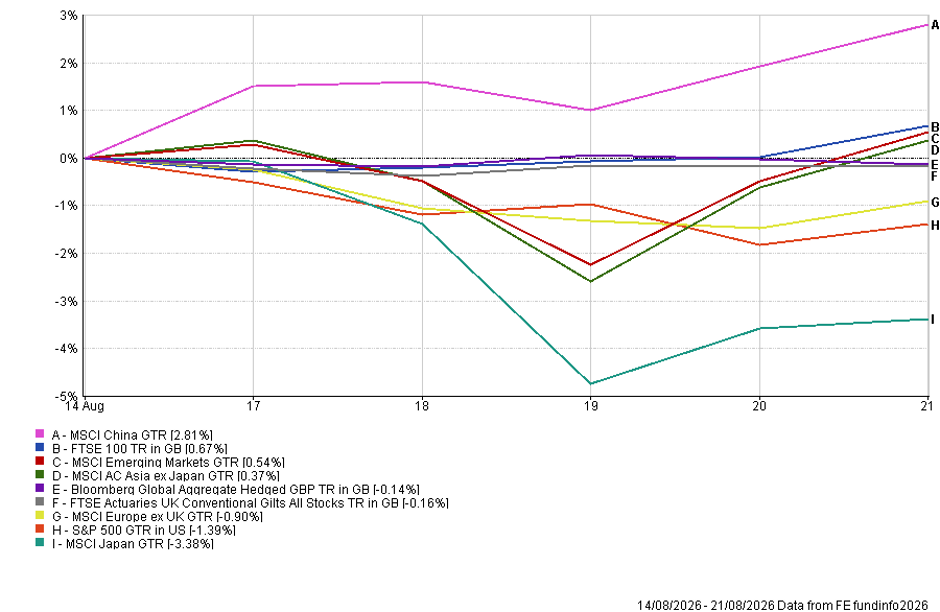
Our chart captures the dispersion nicely. MSCI China rose 2.8% and the FTSE 100 gained 0.7%, while the S&P 500 fell 1.4% and Japan dropped 3.4%. Emerging markets and Asia ex-Japan also eked out gains, whereas Europe ex-UK declined 0.9%. Bonds were surprisingly calm in total-return terms, with global bonds and UK gilts down only fractionally, although that rather understates what was a fairly violent week at the long end of government yield curves.
The bond market flexes its muscles
The most important market development came from US Treasuries. The 30-year yield briefly reached around 5.34%, its highest level since 2007, while the 10-year moved back towards 4.7%. Similar pressures appeared elsewhere: Japanese 10-year yields approached 3%, while long-dated German and French yields also reached levels not seen for many years.
There is no single explanation. Persistent inflation matters, as does the prospect of enormous government borrowing, but there is also an interesting new competitor for capital: the extraordinary financing requirement associated with AI infrastructure. Governments are issuing heavily at the same time that technology companies, utilities and data-centre developers are trying to fund one of the largest private-sector investment booms in history. Capital may be abundant, but it is no longer free.
US hyperscalers have issued around $220 billion of bonds in 2026, compared with just $12.5 billion at the same stage last year, while technology credit spreads have moved wider than the broader investment-grade market. Nvidia’s agreement to guarantee up to $105 billion of OpenAI’s 20-year Ohio data-centre lease reinforces the point: AI financing is becoming a balance-sheet and credit-market question, not merely an equity-valuation one.
The move became uncomfortable enough for US Treasury Secretary Scott Bessent to announce that Treasury would double its buybacks of 10- to 30-year securities to at least $4 billion per operation, with the possibility of going further. The aim is primarily to improve liquidity in older, less actively traded bonds rather than to engineer permanently lower yields, but markets understandably noticed the timing and scale of the expansion. US government debt also passed $40 trillion during the week.
The initial response was dramatic: bond yields fell, equities rallied and the dollar weakened. Unfortunately, much of the bond move unwound within 24 hours. That does not mean the policy has failed—a buyback facility can still improve market functioning—but it does remind us that governments cannot magic away the underlying supply of debt. Ultimately, buyers will demand whatever yield they require to absorb it.
The Federal Reserve did not offer much assistance either. Minutes from July’s meeting showed that several members had been prepared to raise rates and that many believed further tightening would be necessary if inflation failed to return towards 2%. Three policymakers had actually voted for a quarter-point increase. The combination of a hawkish Fed and a Treasury trying to calm the long end is unusual, but it perhaps explains why markets remain uncertain about where US monetary conditions ultimately settle.
Good news is becoming ‘complicated’ news
Ironically, the US economy does not look particularly in need of rescuing. Friday’s flash PMIs were strong overall, but the acceleration was services-led. The services index rose to 56.8 and the composite to 56.0, while manufacturing eased to a five-month low of 53.2. S&P Global said the surveys were consistent with third-quarter growth approaching a 3% annualised pace, roughly twice the second-quarter rate, although firms continued to report elevated price pressures.
That is unquestionably good economic news, but strong growth also makes it harder for the Fed to ease policy while inflation remains above target. This is the slightly awkward regime markets are now inhabiting: the economy is doing better than feared and corporate earnings remain extremely strong, but every piece of evidence supporting faster nominal growth can also place upward pressure on bond yields.
There were some cracks in the consumer story. Walmart suffered its largest one-day fall since 2022 after comparable sales increased 2.6%, below expectations for 3.8%, although the company still raised its full-year revenue and profit forecasts. The miss was not entirely a consumer signal: pharmacy pricing under the Inflation Reduction Act reduced comparable growth by roughly 80 basis points; excluding pharmacy, the increase was 3.4%. Management suggested that high fuel prices were beginning to squeeze households, while e-commerce remained strong, growing 24%. We would not draw too much from a single retailer, but it is another reason to watch the consumer carefully if higher oil and borrowing costs persist.
For equities, rising yields were enough to knock the wind out of some of this year’s strongest performers. The semiconductor index fell around 5% over the week and the Nasdaq dropped more than the broader market. Importantly, however, this has not yet been accompanied by a collapse in earnings expectations. I still think this currently looks more like valuation compression and a bout of AI indigestion rather than anything more sinister.
The UK quietly improves
Closer to home, the UK had a surprisingly respectable week. Inflation did pick up, rising from 2.6% to 2.9% in July, largely because regulated household energy prices increased. Beneath the headline, however, the detail was less alarming. Core inflation remained at 2.6%, services inflation eased from 3.6% to 3.4%, and food inflation slowed to 1.3%; the annual food rate was last lower in September 2021. Private-sector regular pay growth slowed to 2.8%, while vacancies fell to 707,000. This is not a perfect inflation picture, particularly because the latest rise in oil came after the July measurement, but neither does it look like the sort of domestically generated wage-price spiral that caused the Bank of England so much difficulty a few years ago.
Growth data were also better than expected. The flash UK composite PMI rose to 52.5, with services reaching a six-month high of 52.8 against expectations of 51.8. Manufacturing remained in expansion at 51.5. Retail sales fell 0.5% in July after a strong June, although volumes rose 1.1% over the latest three months and remained at their second-highest level since April 2022. August consumer confidence reached a two-year high, albeit at a still-negative -14.
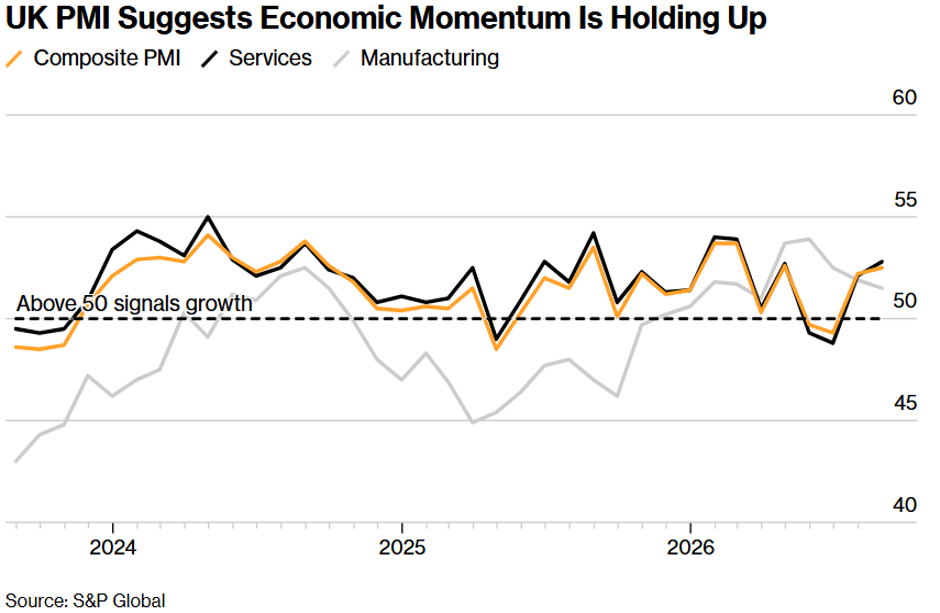
Put together, the UK appears to be muddling through rather better than many expected: moderate growth, gradually cooling domestic inflation and reasonable consumer resilience. Energy remains the obvious fly in the ointment.
Europe: manufacturing wakes up
The eurozone produced perhaps the week’s most encouraging economic surprise. The composite PMI rose to 52.1, its best reading since November, but the interesting part was underneath the headline. Manufacturing PMI jumped to 52.8, its highest for 54 months, while new orders increased at their fastest pace in more than three years and export orders rose for the first time since Russia invaded Ukraine in 2022.
European equities nevertheless fell around 1% over the week. Partly that reflects rising bond yields and partly renewed concern about energy. Markets are also increasingly expecting the ECB to remain hawkish, with a September rate increase largely anticipated and investors beginning to contemplate further tightening if energy inflation persists.
So, rather like America, Europe’s problem at present is not insufficient growth. Better growth is arriving alongside an energy-led headline-inflation shock. The same PMI survey showed easing input and output-price pressures, however, so the key question is whether energy broadens into wages and services rather than assuming that it already has.
China wins the week
Perhaps the most intriguing number on our performance chart is China. MSCI China gained almost 3%, comfortably the strongest major market we track, despite another disappointing set of economic figures. July industrial production increased just 4.5%, retail sales grew only 0.6%, and fixed-asset investment was down 6.7% over the first seven months of the year. Property remains extremely weak, with new-home prices falling 3.2% year-on-year.
The equity market, however, is increasingly telling a different story from the old economy. Chinese technology, AI, robotics and semiconductor businesses are attracting enormous investor interest, while the authorities have signalled additional fiscal measures targeted increasingly towards households and consumption. The People’s Bank left benchmark loan rates unchanged at 3.0% and 3.5%, suggesting Beijing currently prefers targeted fiscal support rather than another indiscriminate monetary stimulus.
Alibaba illustrated both the attraction and the problem beautifully. AI cloud and compute revenues rose 45%, but net income fell 75%, capital expenditure rose 75% and free cash flow was a RMB44.7 billion outflow. At the weekend, the company proposed an HK$80 billion ($10.2 billion) primary share placement, with the proceeds earmarked for chips, infrastructure and models. China is therefore developing its own version of the Western AI debate: demand is real, but shareholders are being asked to fund the returns before they are proven.
Japan feels the other side of higher rates
Japan was the clear laggard, falling more than 3%. Its economy grew at only a 1.1% annualised rate in the second quarter, below the 2% expected. The weakness was concentrated at home: consumption was essentially flat and capital spending fell 1.2%. Yet July exports rose 23.2% to a record and the flash manufacturing PMI reached 55.1, revealing an AI- and export-led economy running well ahead of domestic demand. Meanwhile, the bond market continued to adjust to the end of the country’s ultra-low-rate era.
The 10-year JGB yield reached 2.945%, its highest in roughly three decades, amid concerns about inflation, further Bank of Japan tightening and the government’s expansionary fiscal plans. Japan’s experience is a useful reminder that normalising interest rates after decades of near-zero borrowing costs is unlikely to be completely painless.
Oil remains the joker in the pack
Finally, we cannot escape the Middle East. Brent rose 6.4% over the week, its second consecutive gain, to $94.39, as hopes of an agreement with Iran faded and Hormuz traffic remained exceptionally restricted—only seven commodity vessels crossed on Thursday.
This remains the main threat to what otherwise looks like a surprisingly healthy global economy. Oil around current levels is manageable. A sustained move substantially higher would feed directly into inflation expectations, central-bank policy and bond yields, precisely when governments and companies are already competing heavily for capital. Interestingly, investors sought protection elsewhere. The dollar fell almost 1% over the week, while gold rose more than 5% to above $4,600.
Where does that leave us?
The underlying message is still reasonably constructive. With roughly 90% of MSCI World constituents having reported, LSEG estimates that combined second-quarter net income rose 39.7% year on year. That is an aggregate measure rather than the experience of the median company, but it confirms that the earnings backdrop remains supportive. The latest PMIs likewise suggest that the US, UK and eurozone economies are proving more resilient than feared.
The new complication is the price of money. Higher long-term yields are starting to impose discipline on valuations and on increasingly capital-intensive areas such as AI. That need not end the equity bull market. Indeed, the widening gap between markets—with China and the UK rising while US technology and Japan fell—suggests that we may simply be moving into a broader and less forgiving phase. That is probably healthy. Earnings rather than multiple expansion will increasingly have to do the work.
This Week…
The forthcoming week gives us several useful tests. US July PCE and the second estimate of second-quarter GDP arrive on Wednesday, the same day Nvidia reports. For Nvidia, cash conversion, pricing and further disclosure on customer-financing exposure matter as much as another backlog record. Ofgem’s next price-cap decision will clarify the UK’s immediate energy-inflation path. The week then ends at Jackson Hole, where new Fed Chairman Kevin Warsh will face considerable pressure to explain how he intends to reconcile resilient growth, sticky inflation and an increasingly restless bond market.
For now, the economic expansion remains intact and corporate profits remain strong. But after last week, nobody, not even the US Treasury, can afford to ignore the bond market.
This content is intended for financial professionals only. These are the author’s views at the time of writing and may be subject to change. This content is not intended to provide the basis for any investment advice or recommendation. Any forecasts, figures, opinions, tools, strategies, data, or investment techniques are included for information purposes only.
The information presented is considered to be accurate at the time of production and has been obtained from or based upon sources believed by the author to be reliable and accurate, but no warranty of accuracy is given and no liability in respect of any error or omission is accepted. Please visit our Regulatory Information and Terms of Use pages for more information.

 Production