

Learning to live with geopolitical uncertainty
Author: Tom McGrath, CIO, 8AM Global Limited
*The market observations in this article refer to Friday’s close. Since then, Iran has again declared the Strait of Hormuz closed following a further attack on commercial shipping, prompting fresh US strikes. Markets have not yet had an opportunity to price these developments, making Monday’s response an important test of whether investors still regard the disruption as temporary.
Markets had plenty to deal with this week. The fragile ceasefire around the Strait of Hormuz came under renewed pressure, oil briefly moved higher, the Federal Reserve minutes sounded more hawkish than many investors would have liked, China bounced, the yen strengthened, and attention began to shift towards the next corporate earnings season. In a quieter year, any one of those might have dominated the week. In 2026, they were all competing for space on the same page.
Through Friday, the most important point was that markets did not panic. Investors were clearly not ignoring the geopolitical risks around Iran and the Strait of Hormuz, but they appeared willing to live with them. That may sound complacent, but it’s understandable. The memorandum of understanding between the US and Iran was always likely to be fragile. It was not a peace settlement but rather a temporary arrangement designed to prevent a dangerous situation from becoming unmanageable.
President Trump’s comments at the NATO meeting, where he suggested the ceasefire was effectively over, initially unsettled energy markets. Reports of further attacks on shipping and subsequent US retaliation added to the nervousness. Oil duly spiked, as one would expect, but the move did not become disorderly, and prices subsequently calmed down. By Friday, the US was pressing Iran to state publicly that the Strait of Hormuz remained open and that attacks on shipping would stop, while talks also appeared to be continuing. The market was not assuming the risk had gone away, but it was waiting for evidence of sustained disruption before treating it as a full energy shock.
The issues to watch are not just the headlines, but the physical evidence: whether tankers are still moving, whether LNG flows are disrupted, whether insurance costs rise sharply, whether Brent moves decisively out of its recent range, and whether retaliation remains contained. Until those signals change materially, Hormuz looks more like a recurring source of volatility than the dominant driver of markets. Through Friday’s close, markets were still pricing the disruption as serious but temporary. The weekend escalation makes that conclusion less secure: the next test is whether Iran’s declaration translates into a sustained interruption of oil and LNG flows, rather than another short-lived reduction in traffic.
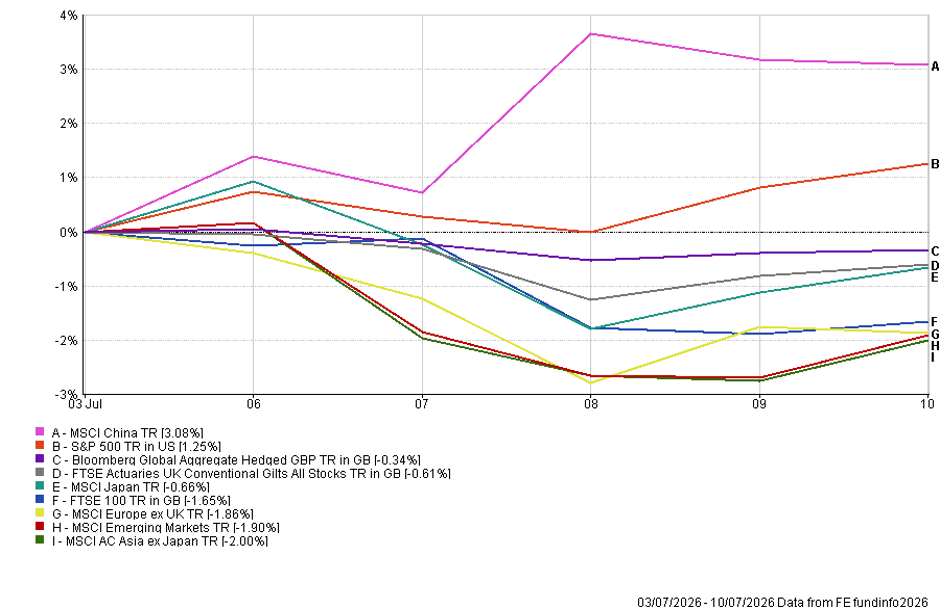
The weekly market numbers support the view that investors remained composed through Friday. This was not a straightforward risk-on week, but nor was it a classic flight to safety. The S&P 500 rose 1.25%, while MSCI China was the standout performer, gaining just over 3%. Elsewhere, however, the picture was weaker. The FTSE 100 fell 1.65%, Europe ex UK declined 1.86%, emerging markets lost 1.90%, and Asia ex Japan was down 2.00%. Bonds were also softer, with UK gilts and global aggregate bonds both slightly lower.
Beneath the S&P 500 gain, leadership remained narrow: the Nasdaq advanced 1.74%, while the Dow and Russell 2000 declined. The week therefore represented a renewed preference for earnings-visible technology exposure rather than a broad return to risk.
This remains a selective and sceptical market, not a euphoric one. Investors were still prepared to buy areas where the earnings story looks convincing, but they were not buying everything indiscriminately.
China’s bounce was one of the more interesting and unexpected moves. After a long period in which Chinese equities have been easy to dislike, the Chinese technology sector had a better week. Some of that may reflect how unloved the market has become. When expectations are low enough, it does not take much to produce a rally. But there is also a more specific angle. Investors continue to look for less crowded ways to gain exposure to the AI and technology supply chain, and China still has companies with genuine scale in internet platforms, cloud infrastructure, electric vehicles, batteries and parts of the domestic AI ecosystem.
We should not get carried away. China has produced plenty of false dawns over recent years, and the structural concerns have not disappeared. Regulation, geopolitics, property weakness, demographics and shareholder returns all remain legitimate worries. But the rally does suggest that investors are willing to look again, particularly where valuations are low and where the technology story feels more tangible. A one-week bounce is not enough to declare a new bull market in China, but it is enough to put China back on the watchlist.
AI: The broader market story remains the AI investment cycle. That phrase risks becoming overused, but it remains the best shorthand for what is driving equity leadership. The important development is that the market is no longer only asking whether Nvidia can sell more chips. It is asking who supplies the memory, who builds the equipment, who provides the power, who secures the data, who finances the capital spending, and who ultimately captures the profits from this enormous investment cycle. That broadening of the AI story has been one of the main reasons markets have remained resilient despite higher rates and geopolitical noise.
This is not quite the same broadening discussed last week. The earlier rotation was across sectors and market capitalisations; this week’s broadening occurred principally within the AI ecosystem, from processors into memory, equipment, power and infrastructure. The longer-term bull case would be stronger if both forms of breadth developed together.
The SK Hynix US listing was a useful symbol of this shift. The South Korean memory-chip maker raised $26.5bn in its US share offering, with its American depositary receipts jumping sharply on debut, underscoring investor appetite for companies viewed as essential suppliers to the AI buildout. SK Hynix is already central to the high-bandwidth memory market, which is critical for AI processors, and the US listing gives it access to a broader investor base as demand for memory is being reassessed.
The more interesting question is whether investors are starting to reclassify memory itself. For decades, memory has been viewed as one of the most cyclical parts of the semiconductor industry: strong demand leads to new capacity, new capacity leads to oversupply, oversupply leads to collapsing prices, and the whole cycle starts again. The argument now being made by SK Hynix management is that AI may have changed the structure of demand. Customers are seeking longer-term supply agreements, high-bandwidth memory remains scarce, and the industry is no longer just supplying PCs and smartphones but the core infrastructure for data centres, AI training and inference.
That is potentially important for valuations. If memory remains a brutally cyclical commodity business, investors will continue to apply modest multiples to Samsung, SK Hynix and Micron. But if AI creates more persistent shortages, longer customer commitments and a structurally higher level of demand, the market may start to treat the memory companies rather differently. It does not mean the cycle has disappeared, and investors should be wary of declaring that any old-economy cycle has been permanently abolished. We have heard that sort of thing before. But it does support the wider picks-and-shovels argument: if AI spending continues, the bottlenecks may lie not only in GPUs but also in memory, power, networking, cooling, equipment, and data-centre infrastructure.
This is why the next earnings season matters so much. The market has been willing to look through a lot because it believes the earnings story, particularly around AI infrastructure, remains intact. Now companies need to prove it. Results from TSMC and ASML will be especially important because they sit close to the centre of the semiconductor supply chain. The large US banks will also matter, but for different reasons. They will give us a read on credit quality, capital markets activity, loan demand and the broader economy.
The US economy remains slightly more robust than the headline GDPNow estimate suggests. The Atlanta Fed’s GDPNow estimate for Q2 real GDP growth is only around 1.4%, which looks underwhelming at first glance. But much of the weakness comes from net exports, with imports rising sharply as US companies bring in the technology equipment needed for the AI buildout. That is a drag on measured GDP, but it is not really a sign of weak domestic demand. In fact, it points in the opposite direction.
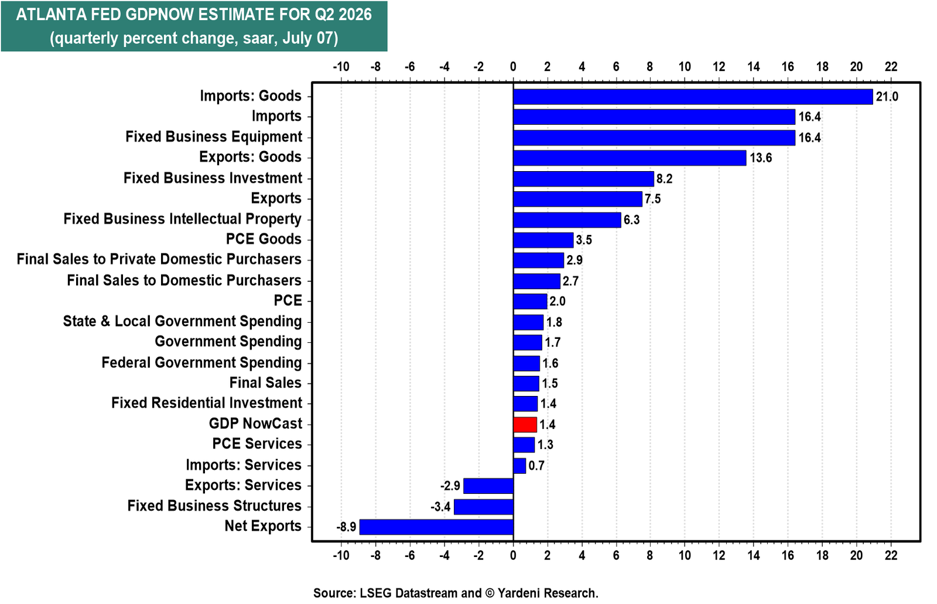
Underneath the headline, the picture looks healthier. Consumer spending appears to have rebounded after a softer first quarter, business fixed investment remains strong, and the labour market is still firm enough to support household income. This is not a boom in the old-fashioned sense, but nor does it look like an economy on the brink of recession.
The June Fed minutes were more hawkish than markets might have hoped. The Fed left rates unchanged at 3.50%-3.75%, but the minutes showed that inflation concerns had become more prominent and that some policymakers saw a case for a rate hike. The Fed also appears increasingly focused on the risk that AI-related demand could put upward pressure on investment, employment, and prices across parts of the economy. AI is no longer just an equity-market theme. It is becoming a macro theme, affecting capital expenditure, imports, electricity demand, labour demand and potentially the neutral rate of interest.
This creates an awkward tension for investors. The same AI cycle that is supporting earnings may also make the Fed less willing to cut rates. If growth remains solid, consumers keep spending, and inflation expectations drift higher, there is little reason for the Fed to provide much policy relief. That does not derail the equity case, but it does raise the bar. Markets can cope with a hawkish Fed if earnings are strong enough. They will find it harder if earnings disappoint and rate cuts remain out of reach.
Japan was also worth noting. The yen strengthened after the government signalled that it wanted large pension funds to increase their investment in domestic assets. Given the scale of Japan’s pension system, even a change in tone can move markets. There are limits to how far the government can push this, because pension assets ultimately need to be managed in the interests of beneficiaries. Still, the signal fits with a broader Japanese policy direction. After years of trying to revive domestic confidence, Japan now has corporate governance reform, wage growth, inflation and a renewed focus on domestic capital formation all pointing in a more constructive direction.
In the UK, politics continued to move quickly, with Andy Burnham now appearing to have secured the support needed to become Labour leader and prime minister. Markets have taken this fairly calmly so far, which is probably the right response. For gilts and sterling, the key questions are not about personalities but about fiscal policy, the choice of Chancellor, and whether the new leadership tries to create room for higher spending or tax cuts at a time when bond markets remain sensitive. UK assets can cope with political change. They are less comfortable with fiscal ambiguity.
So, where does this leave us? Through Friday, investors were treating Hormuz as a manageable rather than systemic risk. The US economy remained resilient, AI investment continued to drive growth, and markets appeared able to absorb a hawkish Fed while earnings held up. The weekend escalation makes that balance less comfortable and leaves markets vulnerable to sharp changes in sentiment. Last week’s broadening thesis remains constructive, but it has not made the market immune to renewed geopolitical shocks or a narrowing of leadership.
Looking ahead…
Earnings now become the main test. If TSMC, ASML and the banks give investors reassurance, markets can probably continue to grind higher despite intermittent geopolitical shocks and a less helpful Fed. If they disappoint, the market has less room for error than it did a few months ago. The AI story remains powerful, but after such a strong run investors will increasingly want evidence rather than enthusiasm.
Inflation is the second test. By Friday, oil had eased from its midweek highs, although the weekend escalation has put that calm back in question. The Fed is looking at a broader set of pressures, including tariffs, electricity demand, wages, consumer expectations and AI-related investment. A benign inflation print would help markets by taking some pressure off rates. A firmer one would reinforce the idea that the next move from the Fed may not be the cut investors spent much of last year waiting for.
The final test is whether both forms of broadening develop together. Wider participation across memory, cloud, cybersecurity and industrial infrastructure would make the AI rally more durable, but a healthier bull market would also require support from financials, industrials, healthcare, smaller companies and selected international markets. China technology and memory broadened the AI story this week; they did not yet confirm a sustained cross-sector rotation.
This content is intended for financial professionals only. These are the author’s views at the time of writing and may be subject to change. This content is not intended to provide the basis for any investment advice or recommendation. Any forecasts, figures, opinions, tools, strategies, data, or investment techniques are included for information purposes only.
The information presented is considered to be accurate at the time of production and has been obtained from or based upon sources believed by the author to be reliable and accurate, but no warranty of accuracy is given and no liability in respect of any error or omission is accepted. Please visit our Regulatory Information and Terms of Use pages for more information.

 Production