

Markets want flows, not just peace!
Author: Tom McGrath, CIO, 8AM Global Ltd
US & IRAN: Markets ended the week in better spirits, but not because the world’s problems have suddenly disappeared. The improvement came from a more practical shift: the worst-case energy scenario has receded, at least for now. The US-Iran memorandum, the tentative reopening of the Strait of Hormuz and the sharp fall in oil allowed investors to step back from outright crisis pricing. Weekend developments, however, have already tested that relief. Iran has again claimed that the Strait is closed, while the US disputes that claim and says commercial traffic is still moving. That leaves markets in a familiar position: less fearful, but still dependent on evidence.
The key issue is physical flow. Ceasefires, memorandums and diplomatic timetables all help sentiment, but the market will judge this by tanker traffic, LNG movements, insurance costs and the reliability of passage through the Strait of Hormuz. Brent’s move back towards $80, after trading close to $100 only a short time ago, takes pressure off inflation expectations, household real incomes, and central bank decision-making. It is particularly helpful for Europe and parts of Asia, where the energy shock had threatened to become a more serious growth problem. But the fall in oil only becomes a genuine macro relief if sustained energy flows match it.
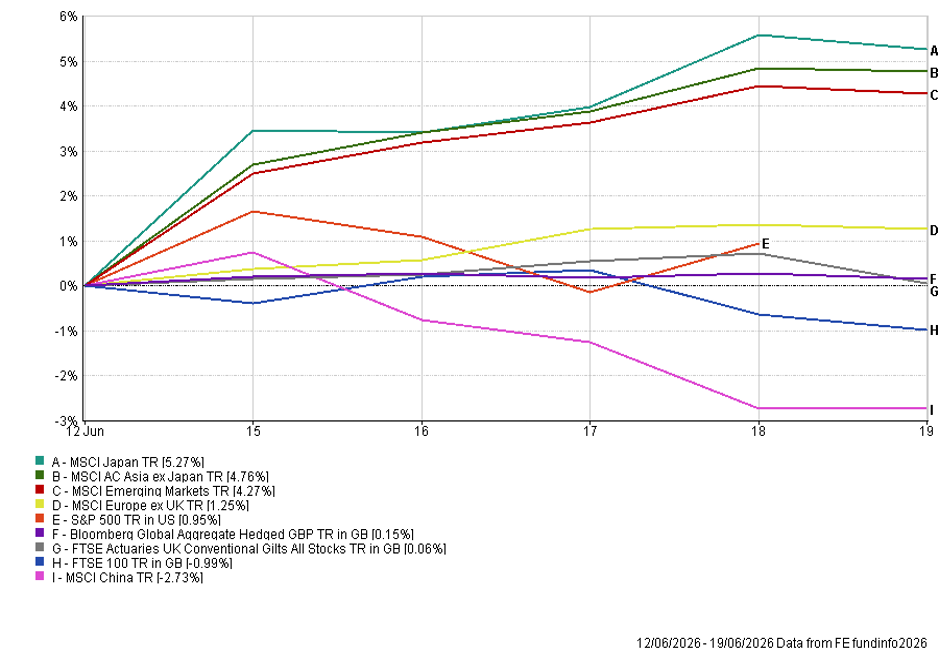
The global index performance chart captured this more nuanced message. Global equities were generally firmer, but the gains were uneven. Japan led the way, up more than 5% over the week, while Asia ex-Japan and emerging markets also did well. Europe made progress, the US rose more modestly before Friday’s market holiday, and the FTSE 100 drifted lower. China was the clear laggard. Bonds were subdued. This was not a broad, indiscriminate risk rally. It was a selective relief move, with investors rewarding lower energy stress, stronger AI momentum and markets with clearer earnings or policy stories.
The regional detail also mattered. Global equity fund flows picked up sharply, with investors adding heavily to US, European and technology funds, but the pattern was still selective rather than indiscriminate. Korea and Taiwan remained the clearest expressions of the AI hardware cycle in Asia. At the same time, China continued to lag, as weak domestic demand, property-sector stress, and limited policy easing weighed on sentiment. India benefited from lower oil, although IT weakness capped the move, and Europe briefly reached new highs before sector dispersion re-emerged.
The US-Iran talks in Switzerland are therefore crucial, but not because investors expect a clean peace settlement within days. Vice President J.D. Vance’s arrival lends the process weight, while Pakistan’s involvement matters given its role as a mediator and execution venue. Yet the talks begin with Iran still trying to use the Strait of Hormuz as leverage and Lebanon still acting as the obvious spoiler. Renewed Israel-Hezbollah fighting has already delayed the diplomacy once, and Israel is not a party to the US-Iran memorandum. The market risk is that Hormuz shifts from a binary closure story into a more persistent regime of permissions, insurance requirements, naval monitoring and higher shipping costs.
President Trump also faces pressure at home. Some Republicans have criticised the memorandum as too accommodating to Tehran, particularly if sanctions relief and financial benefits appear to arrive before firm nuclear concessions. Trump’s own language has become more defensive, insisting that Iran is negotiating from weakness and that no money will be released unless a permanent deal is reached. That may be politically necessary, but it underlines how narrow the path is. The market has welcomed the reduction in tail risk; it has not been given a durable settlement.
UK politics has also moved up the agenda. Andy Burnham’s victory in Makerfield has turned a leadership question into a market-relevant story. Reports that Sir Keir Starmer may set out a timetable for leaving office have been denied, or at least pushed back, by a government source saying he remains focused on governing. The exact timing may be unclear, but the political direction is not. The Prime Minister is under heavy pressure, Burnham is back in Parliament, and investors will be watching whether Labour’s fiscal framework survives a leadership contest.
For gilt markets, the test is not personality but policy. Domestic politics matters most when it changes the expected path of borrowing, taxation or fiscal rules. Burnham has said he would not alter Labour’s fiscal rules if he became Prime Minister. If that remains the line, gilts may continue to take their cue from oil, inflation expectations, global yields and Bank of England policy. If the fiscal message becomes looser, politics will matter much more. Lower energy prices and calmer global bond markets have given the UK some breathing space, but not enough to remove the premium attached to political uncertainty.
The Bank of England had a reasonable week, although not an easy one. It held rates at 3.75%, with seven members voting to hold and two voting to hike. The fall in oil was clearly welcome, but the Bank was not prepared to sound relaxed. Its message was an active hold, not a dovish pivot. UK inflation is still above target, the labour market has softened, and private-sector wage growth has cooled. Retail sales were stronger than expected in May, helped by warm weather and promotions, which reassures consumers a little. It does not settle the debate. The UK remains caught between sticky inflation risk and weaker demand.
In the US, Kevin Warsh made a much louder entrance. This was not just another Fed meeting. It was the first meeting of a new chair who appears determined to change the tone, language and operating style of the central Bank. The Federal Reserve held rates at 3.5%-3.75%, but the message was hawkish. Officials now see a greater risk that inflation will remain too high, and there is growing support for at least one rate increase later this year.
Warsh’s more important signal was about regime change. He wants less forward guidance, shorter communication, a stronger commitment to price stability, and a rethink of the Fed’s balance sheet, research process, and inflation framework. By declining to submit his own dot in the Fed’s projections, he also made a point about uncertainty and the limits of guidance. Markets have spent much of the post-2008 period looking to the Fed for reassurance. Warsh looks less interested in providing it.
That matters because lower oil helps inflation, but Warsh is not offering an immediate liquidity gift in return. The dollar rallied, Treasuries sold off, and markets priced a greater chance of a hike by the autumn. This complicates the relief rally. The energy shock may be fading, but the Fed is not yet ready to ease financial conditions. A firmer dollar and tighter liquidity could still weigh on smaller companies, emerging markets, and more-leveraged parts of the market.
Japan was another important part of the week. The Bank of Japan raised rates to 1.0%, the highest level for decades. Normally, tighter policy would be a headwind for equities, but Japan continues to benefit from corporate reform, shareholder returns, semiconductor exposure and global appetite for AI-linked industrial winners. The Nikkei’s strong performance reflects that broader story. Japan is no longer just a weak-yen export trade; it is increasingly seen as a market with earnings momentum, balance-sheet reform and credible policy normalisation. Higher JGB yields and currency volatility remain the main risks.
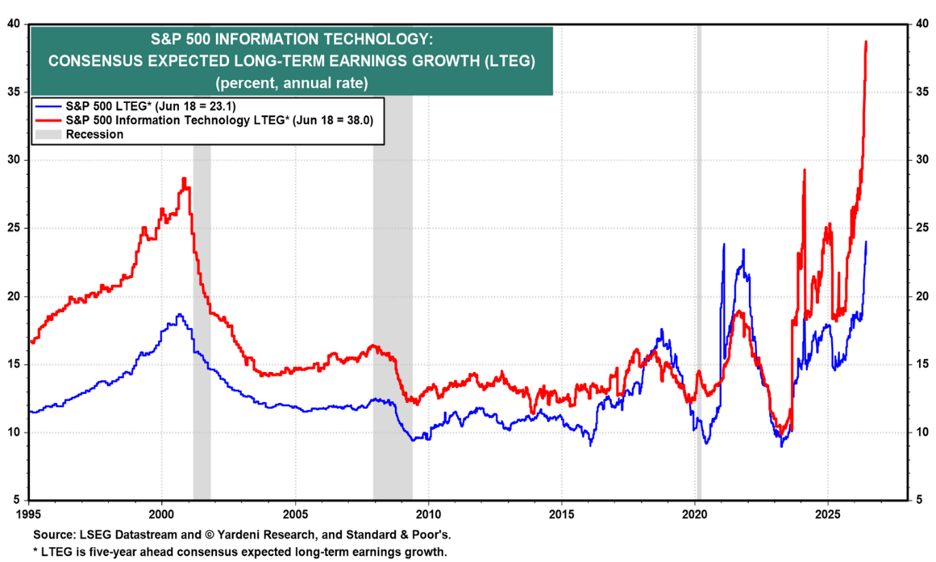
AI infrastructure remains the other market engine. Semiconductors and AI-linked infrastructure stocks recovered after a midweek wobble, with the Nasdaq finishing Thursday strongly ahead of the US market holiday. The market is still prepared to pay for companies linked to compute, memory, power, chips, cooling, grid infrastructure and data-centre build-out. The important distinction from the late-1990s technology bubble is that this rally is still being led more by earnings momentum than by valuation expansion alone. The S&P 500 Technology sector is not trading at anything like the extreme multiples reached in 2000, even as forward earnings expectations continue to rise.
That does not remove the need for discipline. The debate is becoming more grown-up because investors are now asking not just whether AI is exciting, but whether the capital being committed will earn sufficient returns. There are legitimate questions about the quality of some reported earnings, particularly where mark-to-market gains on AI-related investments and circular financing among hyperscalers may inflate near-term profits. But this still looks more like an earnings-led boom than a classic valuation bubble. Forward earnings are rising, the rally is broadening beyond the largest technology stocks, and there is no obvious sign of a credit crunch. The market is therefore moving from narrative to accountability: AI remains a powerful growth engine, but margins, free cash flow, balance-sheet strength, and return on capital will increasingly matter from here.
This week…
The market’s focus shifts from announcement to evidence. Hormuz will be judged by observed flow rather than political language, while Lebanon remains the obvious geopolitical spoiler. The economic calendar will also matter. Flash PMIs across Japan, Europe, the UK and the US will give an early read on whether the energy shock has damaged activity or merely slowed momentum. In the US, May PCE inflation, personal income and spending, durable goods, jobless claims and the final estimate of Q1 GDP will be important for Warsh’s Fed. Micron earnings on 24th June are being treated as a pulse check for AI memory demand, data-centre capex and whether semiconductor profits can keep surprising positively. In Japan, Tokyo inflation and the BoJ’s Summary of Opinions will help frame the next step in policy normalisation.
In summary
The week therefore ends better than it began, but with conditions attached. The energy shock has faded, AI remains a powerful earnings engine and central banks have been given some room to wait. The next stage is about proof: oil flowing, inflation calming, liquidity holding, UK politics staying fiscally credible and AI spending turning into real returns.
Peace would be welcome. For now, flow is enough.
This content is intended for financial professionals only. These are the author’s views at the time of writing and may be subject to change. This content is not intended to provide the basis for any investment advice or recommendation. Any forecasts, figures, opinions, tools, strategies, data, or investment techniques are included for information purposes only.
The information presented is considered to be accurate at the time of production and has been obtained from or based upon sources believed by the author to be reliable and accurate, but no warranty of accuracy is given and no liability in respect of any error or omission is accepted. Please visit our Regulatory Information and Terms of Use pages for more information.

 Production